PROTECTING PURITY AFTER THE PLANT: STORAGE, PACKAGING, AND COLD-CHAIN PROTOCOLS FOR HIGH-PURITY MITRAGYNINE
Author: Adrian S. Siregar, Ph.D. | Editor-in-Chief: Sandy Akbar Nusantara, S.T., M.B.A. | Published: June 25, 2026
Bagikan
Introduction: Extraction Is Only Half the Battle
Producing a high-purity mitragynine extract requires sophisticated cultivation, harvesting, extraction, and purification controls. Yet many manufacturers overlook a critical reality: the degradation mechanisms that threaten mitragynine during extraction do not disappear once the extract leaves the production facility.
Heat, oxygen, moisture, light exposure, and unfavorable chemical environments continue to act on purified alkaloids throughout storage, transportation, and formulation. As a result, a 90%+ mitragynine isolate can gradually lose potency, develop oxidation byproducts, and exhibit measurable compositional drift before it ever reaches a finished product manufacturer.
This downstream stability challenge is particularly important for international supply chains, where extracts may spend weeks in tropical warehouses, shipping containers, customs facilities, and distribution centers before formulation. The question is no longer how to produce a pure extract. The question is how to keep it pure.
The Oxidation Clock Never Stops
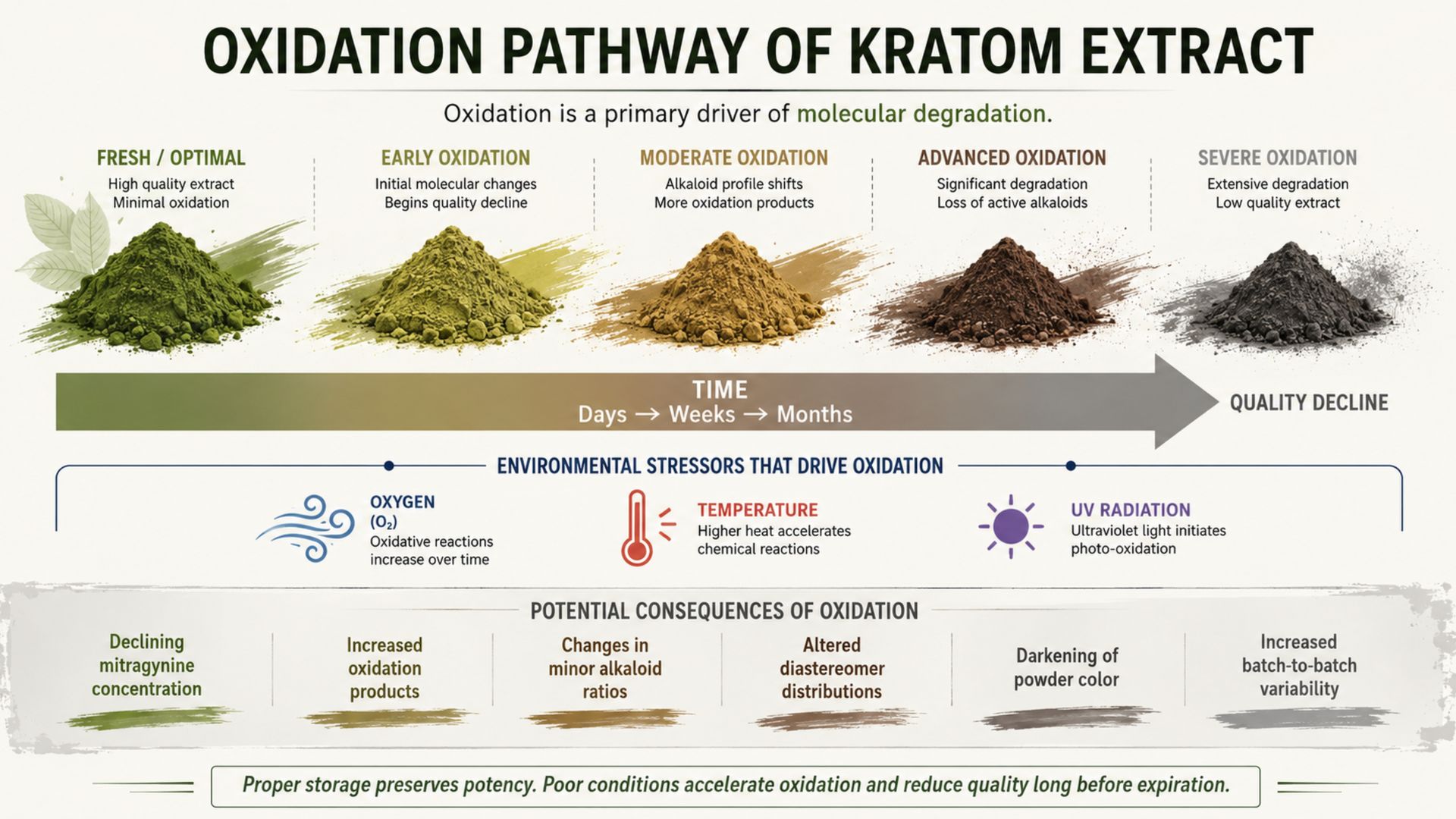
Throughout previous discussions of mitragynine chemistry, one recurring theme emerges: oxidation is one of the primary pathways responsible for molecular degradation.
Even after purification, mitragynine remains chemically active and susceptible to environmental stressors. Exposure to oxygen, elevated temperatures, ultraviolet radiation, and moisture can initiate reactions that gradually alter the alkaloid profile.
Among the most significant concerns is oxidative conversion involving the indole alkaloid structure. Under unfavorable storage conditions, oxidative processes may contribute to the formation of degradation products, including increased levels of oxidized alkaloids and shifts in overall alkaloid composition.
Although the exact degradation pathway depends on storage conditions and matrix composition, improperly stored extracts can exhibit:
Declining mitragynine concentration
Increased oxidation products
Changes in minor alkaloid ratios
Altered diastereomer distributions
Darkening of powder color
Increased batch-to-batch variability
In practical terms, the same oxidative chemistry that extraction scientists work to minimize during processing can reappear months later inside a warehouse or shipping container. A highly purified extract stored under poor conditions may experience meaningful degradation long before its intended expiration date.
Packaging Is the First Line of Defense
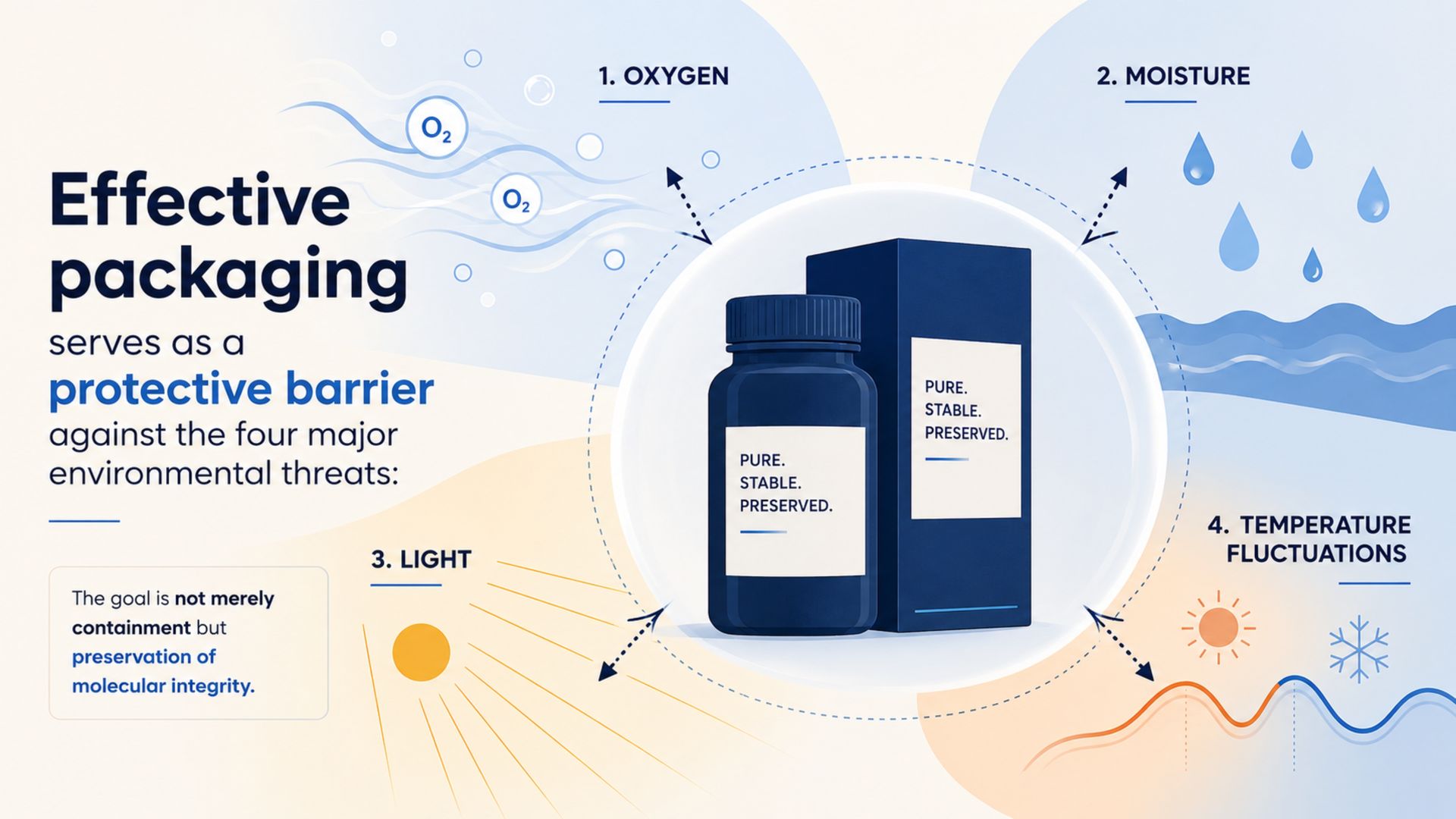
Effective packaging serves as a protective barrier against the four major environmental threats:
Oxygen
Moisture
Light
Temperature fluctuations
The goal is not merely containment but preservation of molecular integrity.
Oxygen Control Through Inert Gas Purging
Oxygen is one of the primary drivers of alkaloid degradation.
Before sealing, containers should be purged with an inert gas such as:
Nitrogen (N₂)
Argon (Ar)
These gases displace atmospheric oxygen within the package headspace, reducing oxidation potential during storage. Argon offers slightly superior oxygen displacement because of its higher density, although nitrogen remains the most widely used and cost-effective option.
Best practice includes:
Headspace oxygen verification
Controlled purge procedures
Validation of sealing effectiveness
Periodic residual oxygen testing
For high-value isolates, maintaining minimal oxygen exposure can significantly improve long-term stability.
Light Protection
Mitragynine-containing materials should be considered light-sensitive. Ultraviolet and visible light exposure can accelerate degradation reactions, particularly when combined with oxygen and elevated temperatures. Recommended packaging materials include:
Amber Glass
Advantages:
Excellent UV protection
Chemically inert
Minimal oxygen permeability
Limitations:
Heavier shipping weight
Breakage risk
Opaque HDPE Containers
Advantages:
Durable
Lightweight
Cost-effective
Limitations:
Higher oxygen permeability than glass
Requires high-quality closure systems
For bulk export shipments, pharmaceutical-grade opaque HDPE containers are often preferred due to their balance of protection and logistics efficiency.
Moisture Management
Moisture is frequently underestimated as a stability risk.
Many botanical extracts exhibit hygroscopic behavior, meaning they absorb moisture from surrounding air. Elevated water activity can accelerate degradation reactions, encourage hydrolysis, and alter powder flow characteristics.
Moisture protection should include:
Pharmaceutical-grade desiccant sachets
Low-moisture packaging environments
Moisture-barrier liners
Controlled warehouse humidity
Desiccant selection should be validated based on package volume and anticipated shelf life.
Induction-Sealed Closures
Container closures are often the weakest point in a packaging system. Even when the primary container material performs well, oxygen can slowly enter through improperly sealed lids. Induction sealing creates a hermetic barrier between the container and closure.
Benefits include:
Reduced oxygen ingress
Improved moisture protection
Tamper evidence
Greater consistency across shipments
For export-grade mitragynine products, induction sealing should be considered a minimum requirement rather than an optional enhancement.
Warehouse Environment Requirements
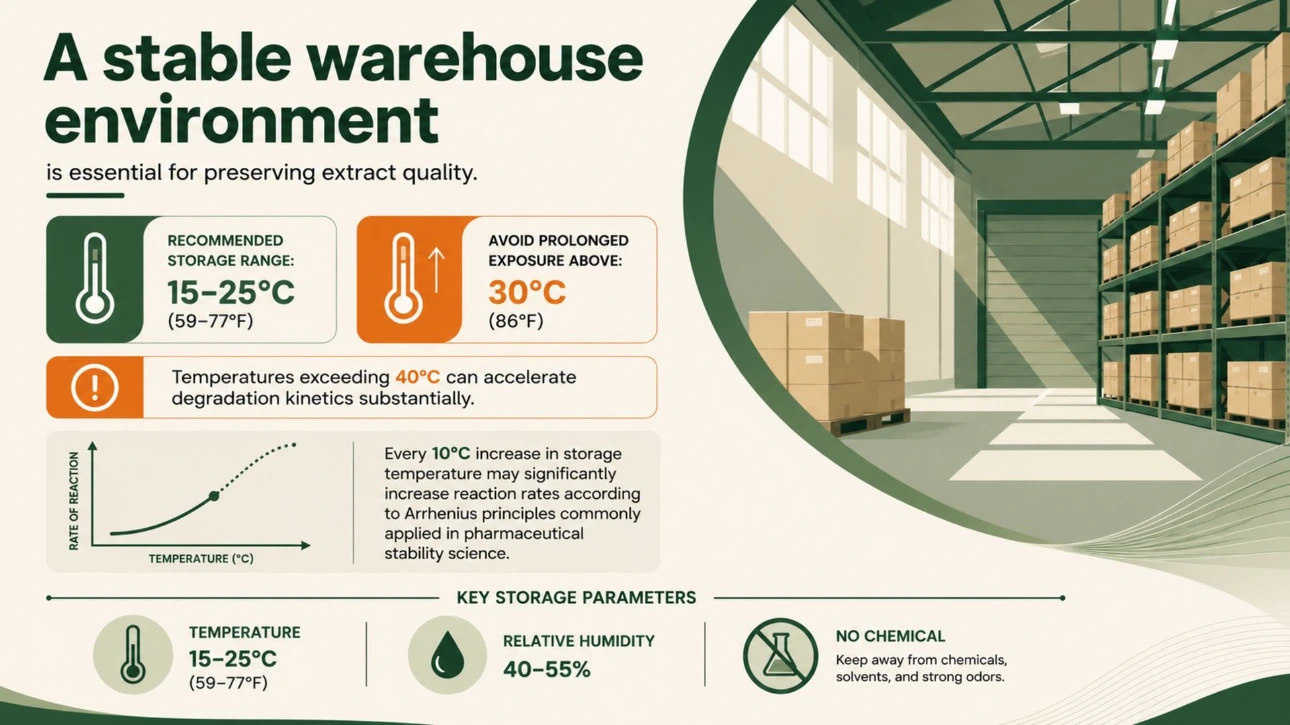
A stable warehouse environment is essential for preserving extract quality.
Recommended storage range: 15–25°C (59–77°F)
Avoid prolonged exposure above: 30°C (86°F)
Temperatures exceeding 40°C can accelerate degradation kinetics substantially. Every 10°C increase in storage temperature may significantly increase reaction rates according to Arrhenius principles commonly applied in pharmaceutical stability science.
Relative Humidity Control
Recommended warehouse humidity:
<60% RH
Preferred target:
40–55% RH
Higher humidity increases:
Moisture uptake
Caking
Packaging stress
Potential degradation reactions
Humidity monitoring should be continuous and documented.
Light Exclusion
Storage areas should minimize exposure to:
Direct sunlight
Skylights
UV-emitting industrial lighting
Bulk materials should remain in original protective packaging until use.
Chemical Segregation
Mitragynine extracts should not be stored near:
Strong oxidizers
Acids
Bases
Solvents with high vapor pressure
Reactive industrial chemicals
Cross-contamination and vapor-phase interactions can create avoidable stability risks.
The Challenge of Tropical Export Hubs
Many mitragynine-producing regions are located in equatorial climates where ambient conditions routinely exceed recommended storage parameters.
Typical environmental conditions may include:
Temperatures above 30°C
Relative humidity above 80%
Significant daily fluctuations
Without climate-controlled storage, extract quality can deteriorate rapidly.
Common risk points include:
Non-air-conditioned warehouses
Port-side storage facilities
Customs holding areas
Inland trucking operations
Manufacturers exporting from tropical regions should validate environmental controls across the entire logistics chain rather than only within production facilities.
Cold-Chain Logistics for International Shipments
International transport introduces some of the highest stability risks.
A shipment may spend several weeks crossing multiple climate zones while exposed to temperature extremes.
Reefer Containers
For high-value extracts, refrigerated shipping containers provide enhanced environmental control.
Typical reefer settings:
15–25°C controlled environment
Continuous monitoring
Temperature recording throughout transit
Although more expensive than conventional freight, reefer transport may be justified for premium extracts intended for pharmaceutical, nutraceutical, or research applications.
Managing Temperature Excursions
A temperature excursion occurs when shipment conditions exceed validated limits.
When an excursion is identified:
Quarantine the shipment.
Review logger data.
Determine duration and severity.
Conduct risk assessment.
Perform confirmatory analytical testing.
Release only after documented approval.
Products should never be automatically accepted following a significant excursion without scientific review.
Shelf-Life Studies: Applying ICH Q1A(R2) Principles
Shelf-life claims should be based on data, not assumptions. The pharmaceutical industry relies on internationally recognized stability protocols described in ICH Q1A(R2), which provide a useful framework for botanical alkaloid products.
Incoming Quality Control SOP for Buyers
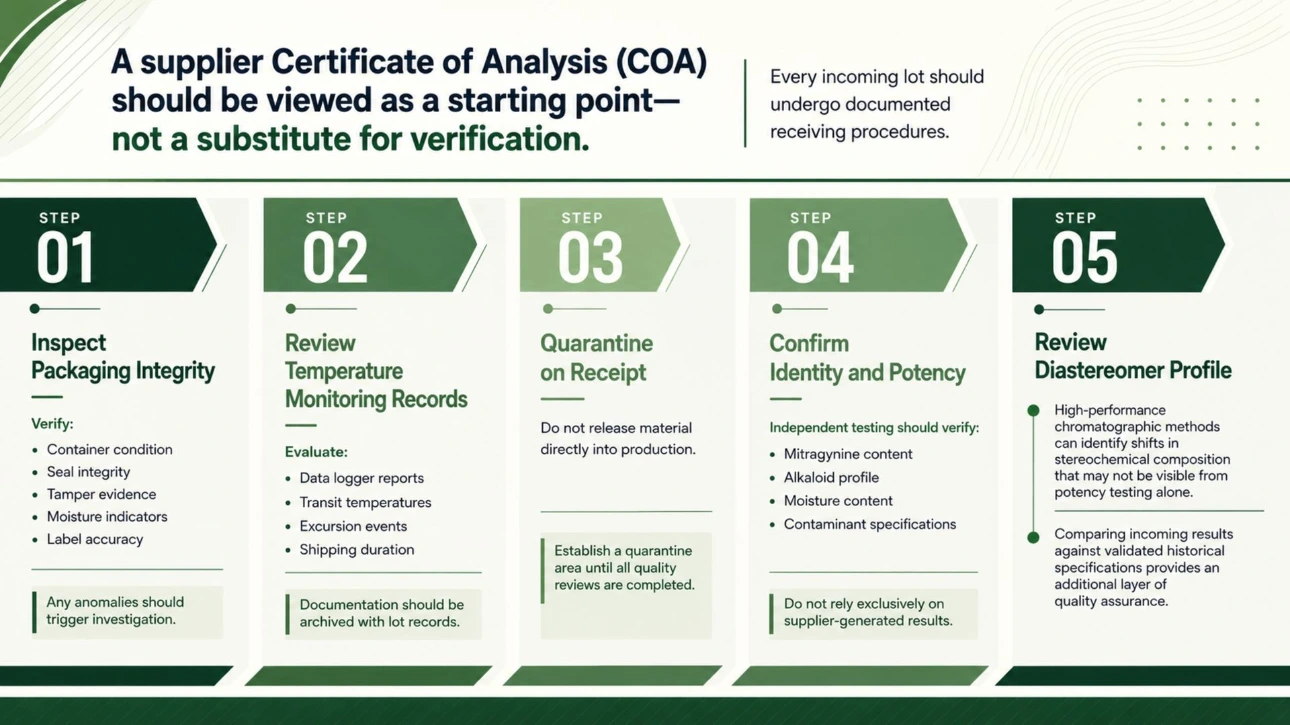
A supplier Certificate of Analysis (COA) should be viewed as a starting point—not a substitute for verification.
Every incoming lot should undergo documented receiving procedures.
Step 1: Inspect Packaging Integrity
Verify:
Container condition
Seal integrity
Tamper evidence
Moisture indicators
Label accuracy
Any anomalies should trigger investigation.
Step 2: Review Temperature Monitoring Records
Evaluate:
Data logger reports
Transit temperatures
Excursion events
Shipping duration
Documentation should be archived with lot records.
Step 3: Quarantine on Receipt
Do not release material directly into production. Establish a quarantine area until all quality reviews are completed.
Step 4: Confirm Identity and Potency
Independent testing should verify:
Mitragynine content
Alkaloid profile
Moisture content
Contaminant specifications
Do not rely exclusively on supplier-generated results.
Step 5: Review Diastereomer Profile
High-performance chromatographic methods can identify shifts in stereochemical composition that may not be visible from potency testing alone. Comparing incoming results against validated historical specifications provides an additional layer of quality assurance.
Building a Storage Specification Program
Every buyer should maintain a written storage specification that defines:
Environmental Requirements
Temperature: 15–25°C
Relative Humidity: <60%
Light protection requirements
Packaging Requirements
Nitrogen or argon purge
Opaque or amber packaging
Desiccant inclusion
Induction-sealed closure
Transportation Requirements
Approved shipping methods
Temperature monitoring expectations
Excursion management procedures
Testing Requirements
Incoming verification testing
Stability monitoring frequency
Retain sample program
A formal specification transforms quality expectations from assumptions into enforceable standards.
Conclusion
Producing a high-purity mitragynine extract is only the first step in preserving product quality. Oxidation, moisture, heat, and light continue to threaten molecular integrity long after extraction has been completed. Without appropriate packaging, climate-controlled storage, validated logistics procedures, and incoming quality controls, even a carefully manufactured extract can lose potency and consistency before reaching the final customer.
Organizations that implement inert-gas packaging, humidity control, temperature monitoring, stability testing, and rigorous receiving SOPs are far more likely to maintain the alkaloid profile they worked so hard to create. In modern botanical ingredient supply chains, extraction quality and storage quality are inseparable. The true measure of manufacturing excellence is not simply how pure an extract is on the day it leaves the plant—it is how pure it remains when it arrives at its destination.
References:
International Council for Harmonisation (ICH). ICH Q1A(R2): Stability Testing of New Drug Substances and Products. Geneva: ICH.
United States Pharmacopeia (USP). General Chapters <659> Packaging and Storage Requirements.
Waterman KC. Adverse effects of humidity on pharmaceutical products. International Journal of Pharmaceutics. 2005;293(1–2):101–125.
Blessy M, Patel RD, Prajapati PN, Agrawal YK. Development of forced degradation and stability indicating studies of drugs. Journal of Pharmaceutical Analysis. 2014;4(3):159–165.
Yadav AV, Dabke AP. Concepts of stability testing of pharmaceutical products. International Journal of Pharma Research and Development. 2010;2(5):1–10.
ASEAN Guidelines on Stability Study of Drug Product. Association of Southeast Asian Nations (ASEAN).
World Health Organization. WHO Technical Report Series: Good Storage and Distribution Practices for Pharmaceutical Products.
United States Food and Drug Administration (FDA). Guidance for Industry: Q1A(R2) Stability Testing of New Drug Substances and Products.
EMA Guideline on Stability Testing: Stability Testing of Existing Active Substances and Related Finished Products.
Kruegel AC, Grundmann O. The medicinal chemistry and neuropharmacology of kratom: A preliminary discussion of a promising medicinal plant and analysis of its potential for abuse. Neuropharmacology. 2018;134(Pt A):108–120.
Hassan Z, Muzaimi M, Navaratnam V, et al. From Kratom to mitragynine and its derivatives: Physiological and behavioural effects related to use, abuse, and addiction. Neuroscience & Biobehavioral Reviews. 2013;37(2):138–151.
Shellie RA, et al. Analytical approaches for characterization and stability assessment of botanical alkaloid preparations. Journal of Chromatographic Science.
United Nations Recommendations on the Transport of Dangerous Goods and Good Distribution Practices for temperature-sensitive materials.
European Commission Guidelines on Good Distribution Practice (GDP) of Medicinal Products for Human Use (2013/C 343/01).
Carstensen JT, Rhodes CT. Drug Stability: Principles and Practices. 3rd Edition. Marcel Dekker