Caffeine: Chemical Structure, Natural Sources, and Side Effects That You Need to Know
Author: apt. Shafina Putri Kamila, S.Farm. | Editor-in-Chief: Sandy Akbar Nusantara, S.T., M.B.A. | Published: 28 Juli, 2026
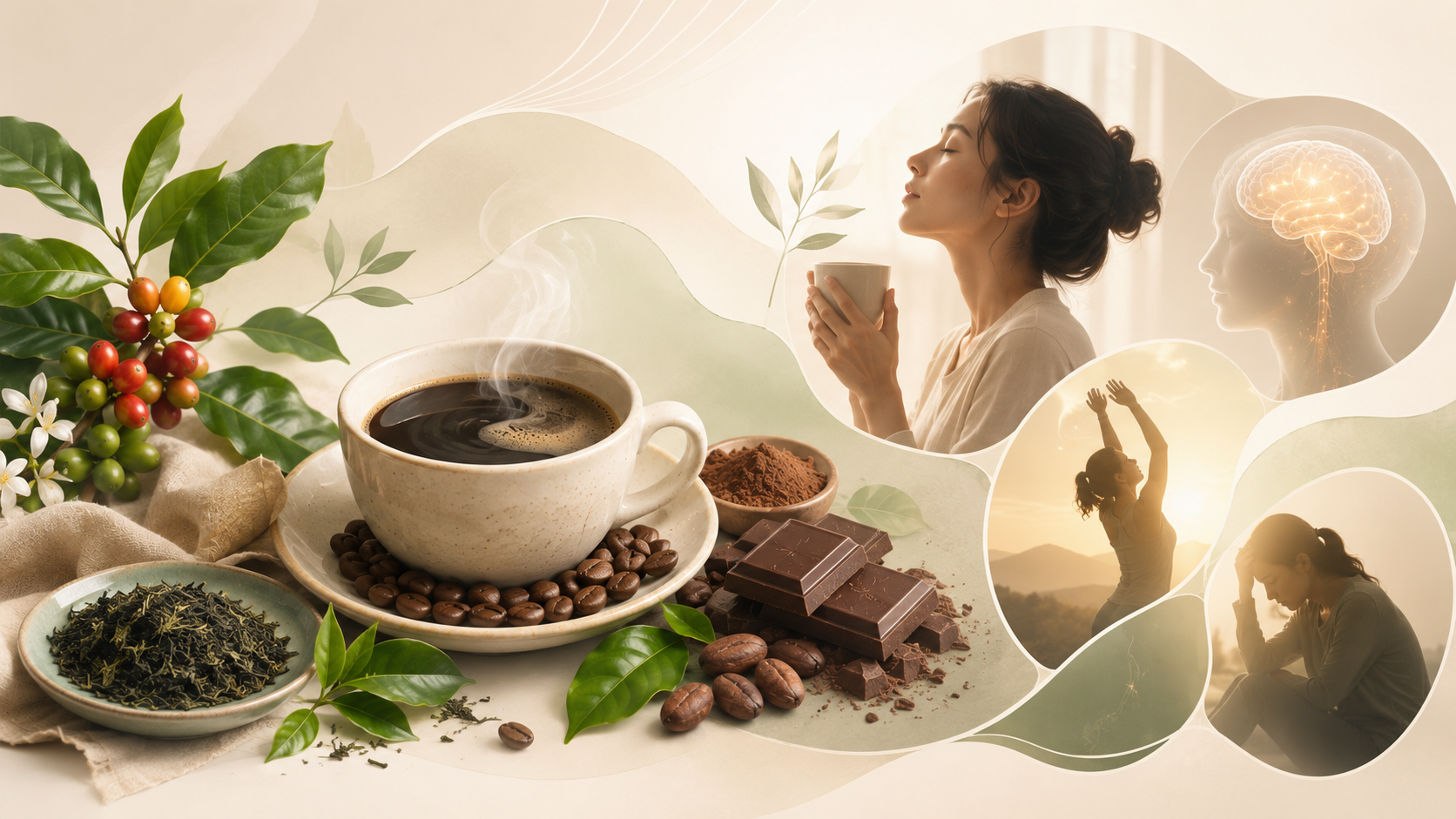
Almost everyone is certainly familiar with caffeine, a compound that is famously found in coffee, a drink that seems to have become an inevitable part of many people's daily lives. However, those who are not used to drinking coffee are likely still quite close to caffeine in their daily lives because caffeine is not only found in coffee. In fact, caffeine is also present in tea and chocolate. So, who is this caffeine that is almost consumed by many people every day? And what is its role in the world of health as well as in the world of research?
Chemical Structure of Caffeine
Caffeine has many other names, including Guaranine, Theine, Methyltheobromine, or 1,3,7-trimethylxanthine. Caffeine is an alkaloid compound and is a derivative of methylxanthine. Chemically, caffeine has a purine base that makes it structurally similar to purine compounds and other purine derivatives such as adenine and guanine, which are compounds that form DNA and RNA, as well as uric acid, which is a compound formed from the breakdown of purines. In addition, caffeine also has structural similarities to natural xanthine compounds such as theobromine, theophylline, and paraxanthine.
Caffeine has thermally stable properties, so it is not damaged by heat. This property is what causes the caffeine content in coffee to not be damaged or disappear even after the coffee beans are roasted to make coffee.
Natural and Everyday Sources of Caffeine
The plant most commonly known as a source of caffeine is the coffee plant or Coffea sp. However, overall, caffeine can actually be found in more than 60 species of plants, including the coffee plant (Coffea sp.), tea (Camellia sinensis L.), chocolate (Theo-broma cacao), guarana plant (Paullinia cupana), and many more3.
In everyday life, caffeine consumption in society mostly comes from beverages. According to a survey conducted by National Health and Nutrition Examination Surveys in 2011–2012, daily caffeine consumption among children and adolescents (15-19 years) came from coffee (24.9%), tea (27.9%), soda (32.9%), energy drinks (10.0%), food (3.4%), and other beverages (0.9%), while for the adult group (35-49 years), the sources of daily caffeine consumption were from coffee (65.0%), tea (16.0%), soda (16%), and other sources (3%)4.
Pharmacological Effects of Caffeine
Caffeine has quite significant pharmacological effects. In fact, there are also medications that use caffeine as their active compound. Caffeine is used as an active compound in various pain relief medications because caffeine has vasoconstrictive and anti-inflammatory activity that can accompany analgesic activity in pain relief medications5.
In addition to its use in medications, the most common use of caffeine in everyday life is as a stimulant to reduce drowsiness, which is usually done by consuming coffee. This is related to the role of caffeine as central nervous system (CNS) stimulant. In the brain, caffeine can act as a competitive antagonist to the effects of adenosine. Adenosine and adenosine receptors themselves regulate the release of neurotransmitters and play an important role in the regulation of sleep and cognitive activity6.
Control of Caffeine Consumption Levels
Although beneficial, caffeine consumption still needs to be controlled. Side effects such as anxiety, insomnia, and psychomotor agitation can occur if caffeine is consumed excessively. Toxic effects are estimated to start appearing at consumption above 1.2 grams, while doses of 10–14 grams are considered fatal4.
However, don't worry, that number is very large compared to the caffeine content in everyday products. For example, the range of caffeine content in some commonly found beverages is as follows7:
- Coffee (240 mL): 76–112 mg
- Tea (240 mL): 25–130 mg
- Soda (240 mL): 23–27 mg
- Energy drink (240 mL): 72–80 mg
Because of the importance of monitoring the amount of caffeine consumed in a day, foods containing caffeine also need to consider the caffeine levels present in a serving size. Popular methods for determining caffeine levels in various media include HPLC, UV/Vis Spectroscopy, thin-layer chromatography, and ion chromatography8.
Are you looking for high-quality caffeine marker compounds for your research?
Get the products you need easily.
Click the purchase button below!

References
1. Reddy, V. S., Shiva, S., Manikantan, S., & Ramakrishna, S. (2024). Pharmacology of caffeine and its effects on the human body. European Journal of Medicinal Chemistry Reports, 10, 100138. https://doi.org/10.1016/j.ejmcr.2024.100138
2. Faudone, G., Arifi, S., & Merk, D. (2021). The medicinal chemistry of caffeine. Journal of Medicinal Chemistry, 64(11), 7156–7178. https://doi.org/10.1021/acs.jmedchem.1c00261
3. Portillo, O. R., & Arévalo, A. C. (2022). Caffeine. A critical review of contemporary scientific literature. Bionatura, 7(3), 1–15. https://doi.org/10.21931/rb/2022.07.03.16
4. Van Dam, R. M., Hu, F. B., & Willett, W. C. (2020). Coffee, caffeine, and health. New England Journal of Medicine, 383(4), 369–378. https://doi.org/10.1056/nejmra1816604
5. Temple, J. L., Bernard, C., Lipshultz, S. E., Czachor, J. D., Westphal, J. A., & Mestre, M. A. (2017). The Safety of Ingested Caffeine: A Comprehensive review. Frontiers in Psychiatry, 8, 80. https://doi.org/10.3389/fpsyt.2017.00080
6. Fiani, B., Zhu, L., Musch, B. L., Briceno, S., Andel, R., Sadeq, N., & Ansari, A. Z. (2021). The neurophysiology of caffeine as a central nervous system stimulant and the resultant effects on cognitive function. Cureus, 13(5), e15032. https://doi.org/10.7759/cureus.15032
7. Heckman, M. A., Weil, J., & De Mejia, E. G. (2010). Caffeine (1, 3, 7‐trimethylxanthine) in Foods: A Comprehensive review on consumption, functionality, safety, and regulatory matters. Journal of Food Science, 75(3), R77-87. https://doi.org/10.1111/j.1750-3841.2010.01561.x
8. Grujić-Letić, N., Rakić, B., Šefer, E., Milanović, M., Nikšić, M., Vujić, I., & Milić, N. (2016). Quantitative determination of caffeine in different matrices. Macedonian Pharmaceutical Bulletin, 62(1), 77–84. https://doi.org/10.33320/maced.pharm.bull.2016.62.01.007
Editorial Team:
- Rafi Rif'atul Rizki, S.I.Kom.