Eugenol: Aromatic Compound from Clove Oil and Its Various Benefits
Author: apt. Shafina Putri Kamila, S.Farm. | Editor-in-Chief: Sandy Akbar Nusantara, S.T., M.B.A. | Published: 17 September 2026
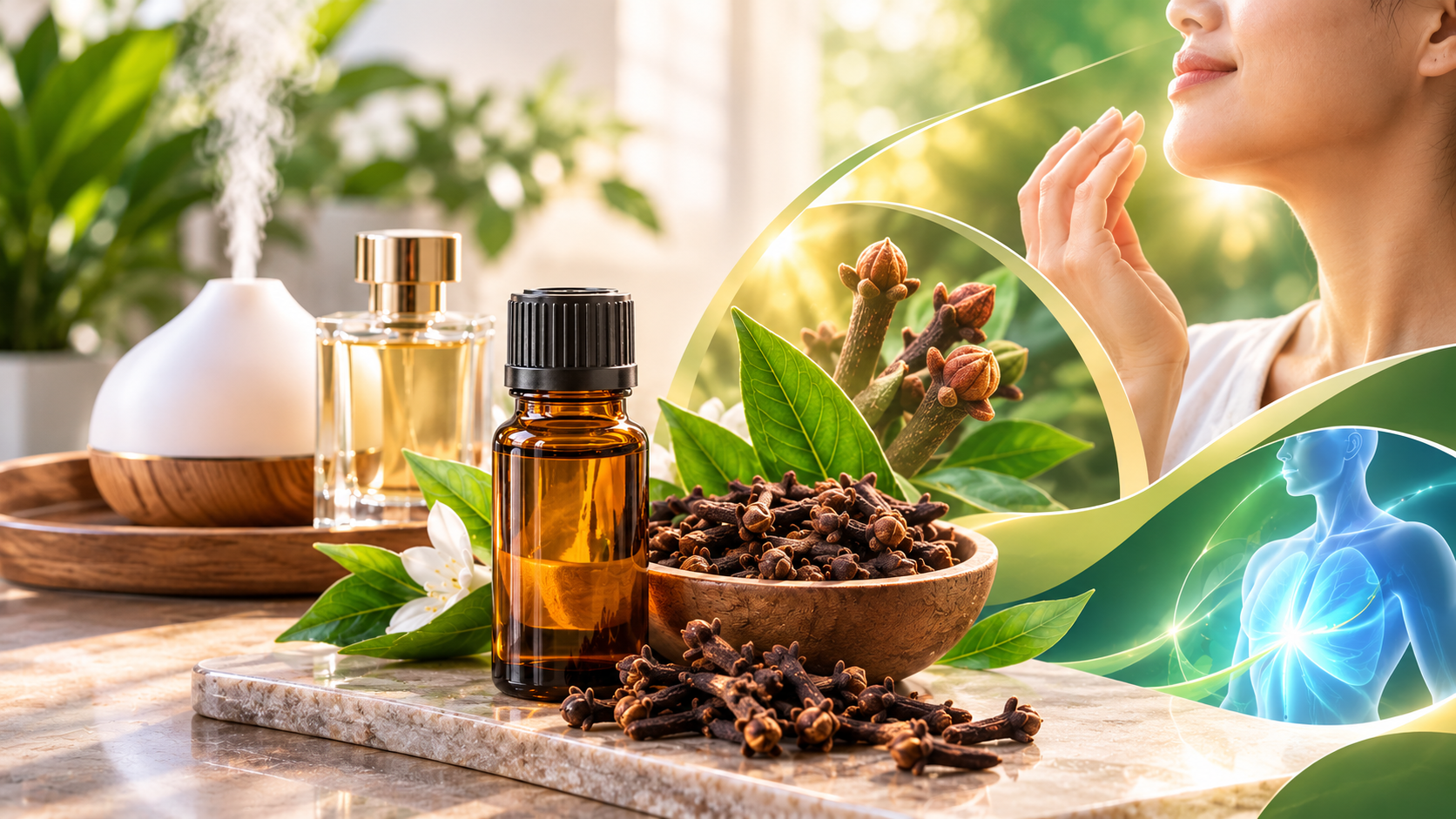
Do you use fragrance products like perfume and diffuser? If familiar with those products, you are surely also familiar with the term that is closely related to them, which is essential oil or volatile oil. Essential oil is the main ingredient and one of the substances known to contribute to the distinctive fragrance of each of those products.
However, essential oil is not only used as a fragrance provider. Essential oils themselves contain various compounds within them, and these compounds also have other benefits, including benefits in the field of health. One of the compounds that is quite often isolated from essential oil is eugenol which is one of the main compounds in clove oil or clove oil.
Eugenol: Definition, Structure, and Physicochemical Properties
Eugenol (C10H12O2) or 4-allyl-2-methoxyphenol is an aromatic compound that belongs to the phenylpropanoid group. Purified eugenol has an oily liquid form that is clear to pale yellow and has a strong aroma1, 2. This compound is a volatile compound or easily evaporates and has low chemical stability because it is sensitive to oxidation and various other chemical interactions1.
Sources and Acquisition of Eugenol
Eugenol is the main component of essential oil obtained from the distillation of clove leaves and flowers (Eugenia caryophyllata or Syzygium aromaticum) commonly referred to as clove oil3. However, eugenol can also be found in several other plants such as holy basil (Ocimum tenuiflorum), ginger (Zingiber officinale), cinnamon (Cinnamomum verum), turmeric (Curcuma longa), nutmeg (Myristica fragrans), and basil (Ocimum basilicum). Among these plants, eugenol is the main compound for cloves with a content of 45-90%2. Eugenol from its natural sources can be extracted and isolated from essential oil using methods such as steam distillation, extraction with organic solvents, hydro-distillation, supercritical carbon dioxide extraction4.
In addition to being isolated from its natural sources, eugenol can also be synthesized through the process of guaiacol allylation using allyl chloride or produced through biotransformation processes using microorganisms such as Escherichia coli, Corynebacterium sp., and Bacillus cereus5.
The Broad Benefits of Eugenol
The use of Eugenol in various everyday products is quite extensive, covering products personal hygiene such as perfumes, creams, lotions, soaps, and detergents, as well as food products such as beverages, baked foods, and candies6. The extensive use of eugenol is certainly related to its broad activities. Eugenol is known to have various activities including antimicrobial, antioxidant, analgesic, antimutagenic, anti-platelet, anti-allergic, and anti-inflammatory.
Eugenol is a well-known antioxidant compound and monoamine oxidase (MAO) inhibitor. The antioxidant activity of eugenol includes scavenging free radicals, preventing the production of reactive nitrogen species, enhancing the potential cyto-antioxidant, and protecting microbial DNA and protein functions1. This role gives eugenol the ability to prevent diseases related to free radicals such as cancer, inflammatory conditions, type-2 diabetes, cardiovascular diseases, neurodegenerative diseases such as Parkinson’s disease, and periodontal disease2, 6.
Eugenol is also quite well-known for its antimicrobial activity. As an antimicrobial, the antimicrobial effects of eugenol include several groups of gram-positive and gram negative bacteria, fungi, and some parasites such as Giardia lamblia, Fasciola gigantica, and Haemonchus contortus1. Various results of testing the effectiveness of eugenol against various microbes yield diverse results due to differences in strain, methods, and the concentration of eugenol samples used can produce varying results. It is noteworthy that the antimicrobial activity of eugenol is known to stem from its ability to interfere with the physiological activities of microorganisms through several mechanisms, such as disrupting membrane function, suppressing virulence factors, toxins, and enzymes, as well as interfering with biofilm formation7.
In the field of dentistry, eugenol is not only used as a disinfectant due to its antibacterial activity but also as an analgesic to reduce local pain when applied topically. The analgesic activity of eugenol is thought to be related to the inhibition of channel calcium8, 9.
Additionally, one of the other potentials of eugenol is as a cardiovascular protector. Based on research conducted by Venkadeswaran et al., eugenol has the potential as an antihypercholesterolemic and antiatherogenic. Administration of eugenol to rats induced with hyperlipidemia showed significant reductions in total cholesterol, LDL-C, and triglycerides2, 10.
Eugenol is classified as generally recognized as safe (GRAS) or generally considered safe by the U.S. Food and Drug Administration9. However, there are still things to consider in the use of eugenol is its toxicity. Although in low and controlled doses eugenol can act as an antioxidant, at high doses, eugenol can become pro-oxidant and can increase the production of reactive oxygen species (ROS). The pro-oxidant activity of eugenol is one of the main causes of eugenol toxicity1.
Looking for high-quality Eugenol marker compounds for your research?
Get the products you need easily.
Click the purchase button below!

References
1. Ulanowska, M., & Olas, B. (2021). Biological Properties and Prospects for the Application of Eugenol—A review. International Journal of Molecular Sciences, 22(7), 3671. https://doi.org/10.3390/ijms22073671
2. Nisar,M. F., Khadim, M., Rafiq, M., Chen, J., Yang, Y., & Wan, C. C. (2021). Pharmacological properties and health benefits of Eugenol: A Comprehensive review. Oxidative Medicine and Cellular Longevity, 2021(1), 2497354. https://doi.org/10.1155/2021/2497354
3. Kamatou, G. P., Vermaak, I., & Viljoen, A. M. (2012). Eugenol—From the remote Maluku islands to the international market place: a review of a remarkable and versatile molecule. Molecules, 17(6), 6953–6981. https://doi.org/10.3390/molecules17066953
4. Khalil, A. A., Rahman, U. U., Khan, M. R., Sahar, A., Mehmood, T., & Khan, M. (2017). Essential oil eugenol: sources, extraction techniques and nutraceutical perspectives. RSC Advances, 7(52), 32669–32681. https://doi.org/10.1039/c7ra04803c
5. Abrahão M. R., Molina G., & Pastore G. M., Endophytes. (2013). Recent developments in biotechnology and the potential for flavor production, Food Research International. 52, no. 1, 367–372, https://doi.org/10.1016/j.foodres.2013.03.007
6. Fujisawa, S., & Murakami, Y. (2016). Eugenol and Its Role in Chronic Diseases. In Advances in Experimental Medicine and Biology (pp. 45–66). Springer International Publishing. https://doi.org/10.1007/978-3-319-41342-6_3
7. Marchese, A., Barbieri, R., Coppo, E., Orhan, I. E., Daglia, M., Nabavi, S. F., Izadi, M., Abdollahi, M., Nabavi, S. M., & Ajami, M. (2017). Antimicrobial activity of eugenol and essential oils containing eugenol: A mechanistic viewpoint. Critical Reviews in Microbiology, 43(6), 668–689. https://doi.org/10.1080/1040841X.2017.1295225.
8. Pramod, K., Ansari, S. H., & Ali, J. (2010). Eugenol: A Natural Compound with Versatile Pharmacological Actions. Natural Product Communications, 5(12), 1999–2006. https://doi.org/10.1177/1934578x1000501236
9. Zari, A. T., Zari, T. A., & Hakeem, K. R. (2021). Anticancer properties of Eugenol: a review. Molecules, 26(23), 7407. https://doi.org/10.3390/molecules26237407
10. Venkadeswaran K., Muralidharan A. R., Annadurai T., Ruban V. V., Sundararajan M., Anandhi R., Thomas P. A., and Geraldine P., Antihypercholesterolemic and antioxidative potential of an extract of the plant, Piper betle, and its active constituent, eugenol, in triton WR-1339-induced hypercholesterolemia in experimental rats, Evidence-based Complementary and Alternative Medicine. (2014) 2014, 11, https://doi.org/10.1155/2014/478973, 2-s2.0-84893182728, 24523820, 478973.
Editorial Team:
- Rafi Rif'atul Rizki, S.I.Kom.