Understanding Catechins: From Natural Antioxidants to Marker Compounds in Quality Control
Author: apt. Shafina Putri Kamila, S.Farm. | Editor-in-Chief: Sandy Akbar Nusantara, S.T., M.B.A. | Published: July 28, 2026
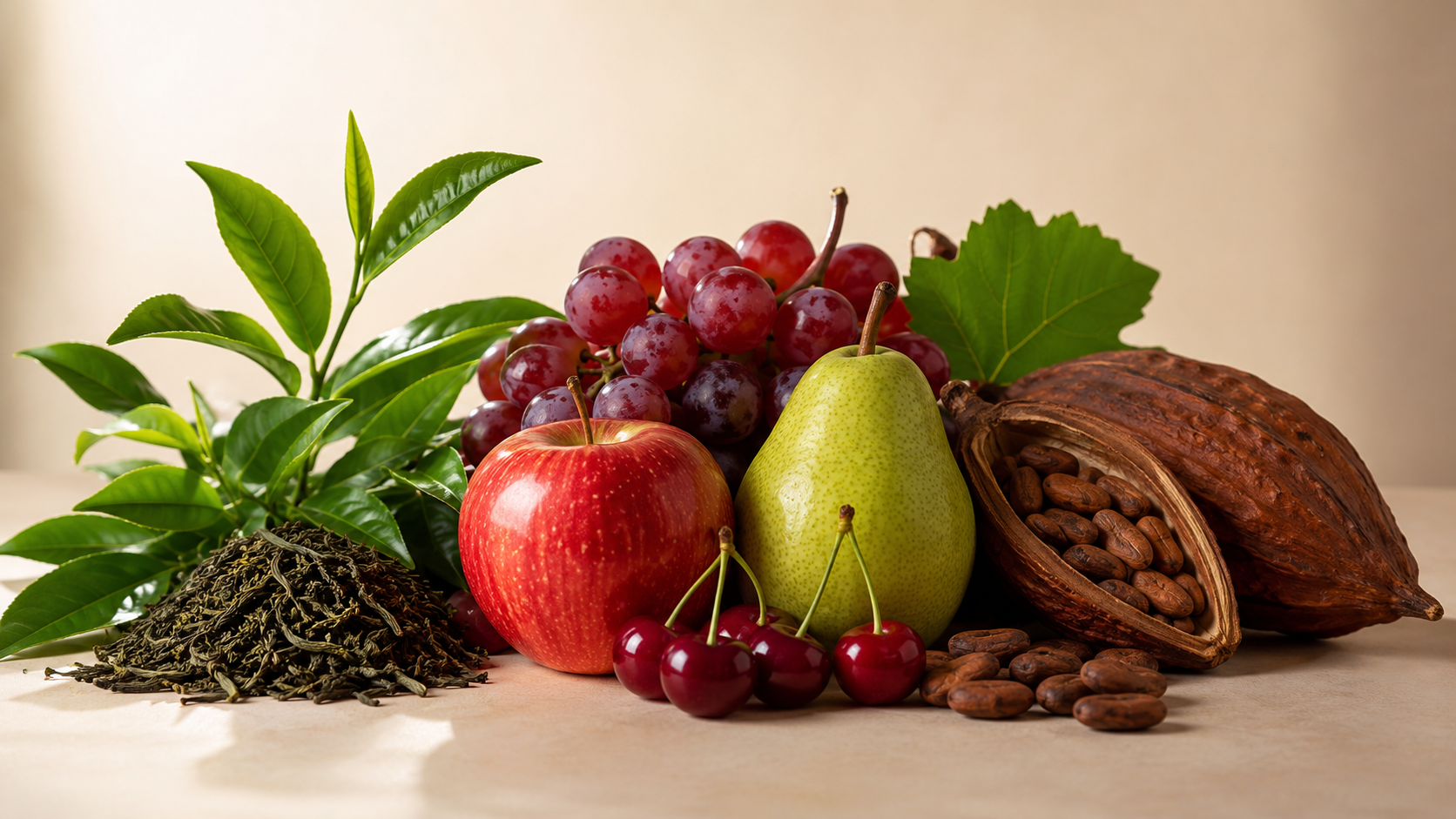
Have you ever felt astringent and dry sensations on your tongue when drinking tea? Or perhaps the distinctive bitterness of dark chocolate? Behind these sensations, there is a bioactive compound called Catechin. The name “catechin” (or commonly referred to as Catechins in English) is derived from the word catechu which refers to the plant Acacia catechu1. However, catechin compounds are not limited to that plant. In fact, the majority of the main sources of catechins are food items that we often consume, including the leaves of Camelia sinensis or more commonly known as the tea plant, fruits such as grapes, apples, pears, and cherries, as well as cocoa which is the base ingredient of chocolate2,3.
Characteristics of Catechin Compounds
Catechins are a group of compounds that belong to the class of flavan-3-ol compounds. Based on their structure, catechins are divided into two categories, namely:
- Free catechins, which consist of catechin, gallocatechin, epicatechin (EC), and epigallocatechin (EGC), as well as
- esterified catechins, which consist of epigallocatechin gallate (EGCG), epicatechin gallate (ECG), gallocatechin gallate (GCG), and catechin gallate (CG)).
One of the distinctive properties of catechins is their astringent-ness which gives a dry and rough sensation on the tongue. Esterified catechins have a stronger astringent property and tend to have a bitter taste, while free catechins have a slightly sweeter taste4. Catechins can dissolve in polar solvents such as water and methanol, but their solubility depends on the specifications of the catechin extraction process2.
Catechins in Our Daily Life
The presence of catechins is abundant in our daily lives. One of the most well-known sources of catechins is tea leaves. Based on the level of processing, tea leaves can be categorized into three types, namely green tea, black tea, and oolong tea. Among these three types of tea, Green Tea or green tea has the highest content of catechins. This is because green tea is unfermented tea, so the polyphenols contained in it, including catechins, have not been oxidized. The content of catechin compounds in green tea leaves can reach about 30% of its dry weight, surpassing various other contents such as carbohydrates (25%), protein (15%), lignin (6.5%), and caffeine (3%)4.
In fruits such as apples, blackberries, cherries, grapes, pears, raspberries, and cacao, the catechin compound that can be found in large amounts is epicatechin. Meanwhile, in strawberries, catechin (C) occupies the largest portion at 75% of total catechins, followed by epicatechin gallate (ECG) at 18%, and epigallocatechin (EGC) at 5%5.
Antioxidant Properties of Catechins
The role of catechins as antioxidants is well known widely. Many studies have been conducted regarding various types of antioxidant activities of catechins. Related to radical scavenging activity, several studies show that (−)-epigallocatechin gallate has the highest radical scavenging activity. There are also other studies that demonstrate that (−)-epigallocatechin gallate and (−)-epicatechin gallate show the most significant cell protection activity against hemolysis induced by hypochlorite6.
In a study comparing the activities of several antioxidant compounds dissolved in saline solution, (+)-catechin became the most potent compound in protecting against damage caused by peroxyl radicals AAPH, Its potency order is followed by (−)-epicatechin, caffeic acid, deferoxamine, (−)-epicatechin gallate, (−)-epigallocatechin gallate, chlorogenic acid, ascorbic acid and uric acid6.
The Role of Catechins in Quality Control
Catechins are known as active compounds that are responsible for the natural antioxidant benefits of tea beverages, therefore, for industry players and researchers, the presence of catechin compounds becomes one of the quality parameters that are highly considered especially in the following aspects:
- Standardization of Herbal Products: The level of catechins becomes a primary indicator of quality for several herbal products, extracts, and simplicia;
- Ensuring Consistency Batch-to-Batch: Catechins serve as marker compounds that help producers ensure that each production batch has a uniform composition and quality.
Looking for high-quality Phyllanthin marker compounds for your research?
Get the products you need easily.
Click the purchase button below!

References
1. Braicu, C., Ladomery, M. R., Chedea, V. S., Irimie, A., & Berindan-Neagoe, I. (2013). The relationship between the structure and biological actions of green tea catechins. Food Chemistry, 141(3), 3282–3289. https://doi.org/10.1016/j.foodchem.2013.05.122
2. Gadkari, P. V., & Balaraman, M. (2013). Catechins: Sources, extraction and encapsulation: A review. Food and Bioproducts Processing, 93, 122–138. https://doi.org/10.1016/j.fbp.2013.12.004
3. Raab, T., Barron, D., Vera, F. A., Crespy, V., Oliveira, M., & Williamson, G. (2010). Catechin Glucosides: Occurrence, Synthesis, and Stability. Journal of Agricultural and Food Chemistry, 58(4), 2138–2149. https://doi.org/10.1021/jf9034095
4. Vuong, Q. V., Golding, J. B., Nguyen, M., & Roach, P. D. (2010). Extraction and isolation of catechins from tea. Journal of Separation Science, 33(21), 3415–3428. https://doi.org/10.1002/jssc.201000438
5. Wangkarn, S., Grudpan, K., Khanongnuch, C., Pattananandecha, T., Apichai, S., & Saenjum, C. (2021). Development of HPLC method for catechins and related compounds determination and standardization in Miang (Traditional Lanna fermented tea leaf in northern Thailand). Molecules, 26(19), 6052. https://doi.org/10.3390/molecules26196052
6. Grzesik, M., Naparło, K., Bartosz, G., & Sadowska-Bartosz, I. (2017). Antioxidant properties of catechins: Comparison with other antioxidants. Food Chemistry, 241, 480–492. https://doi.org/10.1016/j.foodchem.2017.08.117
[Note]
MarkHerb products that can be-linked at the end of the article:
1. Catechin (https://www.markherb.com/en/shop/catechin-294)
2. Gallocatechin (https://www.markherb.com/en/shop/gallocatechin-635)
3. Catechin Gallate (https://www.markherb.com/en/shop/catechin-gallate-474)
4. Epicatechin (https://www.markherb.com/en/shop/epicatechin-417)
5. Epigallocatechin (https://www.markherb.com/en/shop/epigallocatechin-605)
6. Epigallocatechin gallate (https://www.markherb.com/en/shop/epigallocatechin-gallate-409)
7. Epicatechin Gallate (https://www.markherb.com/en/shop/epicatechin-gallate-475)
Editorial Team:
- Rafi Rif'atul Rizki, S.I.Kom.