Tamanu Polyphenol: Harnessing the Power of Nature Through Liposome Multiplier Delivery Technology
Author: Adrian S. Siregar, Ph.D. | Editor-in-Chief: Sandy Akbar Nusantara, S.T., M.B.A. | Published: July 30, 2026

For centuries, the oil extracted from the nuts of Calophyllum inophyllum L., known throughout the Pacific Islands as tamanu oil, has been revered as a traditional panacea for wound healing, skin ailments, and inflammation. Modern scientific inquiry has progressively validated these ancestral claims, revealing that the oil's therapeutic prowess derives largely from a complex matrix of bioactive compounds, most notably a diverse array of polyphenols. However, like many potent natural compounds, tamanu polyphenols face significant challenges in stability and bioavailability when applied topically.
This is where the convergence of ancient wisdom and cutting-edge delivery technology becomes transformative. The Liposome Multiplier, an advanced liposomal encapsulation system, represents a paradigm shift in how tamanu polyphenols are delivered to the skin. By encapsulating polyphenol-rich fractions within nanoscale lipid vesicles, this technology multiplies the functional impact of each active molecule, ensuring deeper penetration, enhanced stability, and markedly superior therapeutic outcomes.
The Bioactive Arsenal of Tamanu Polyphenols
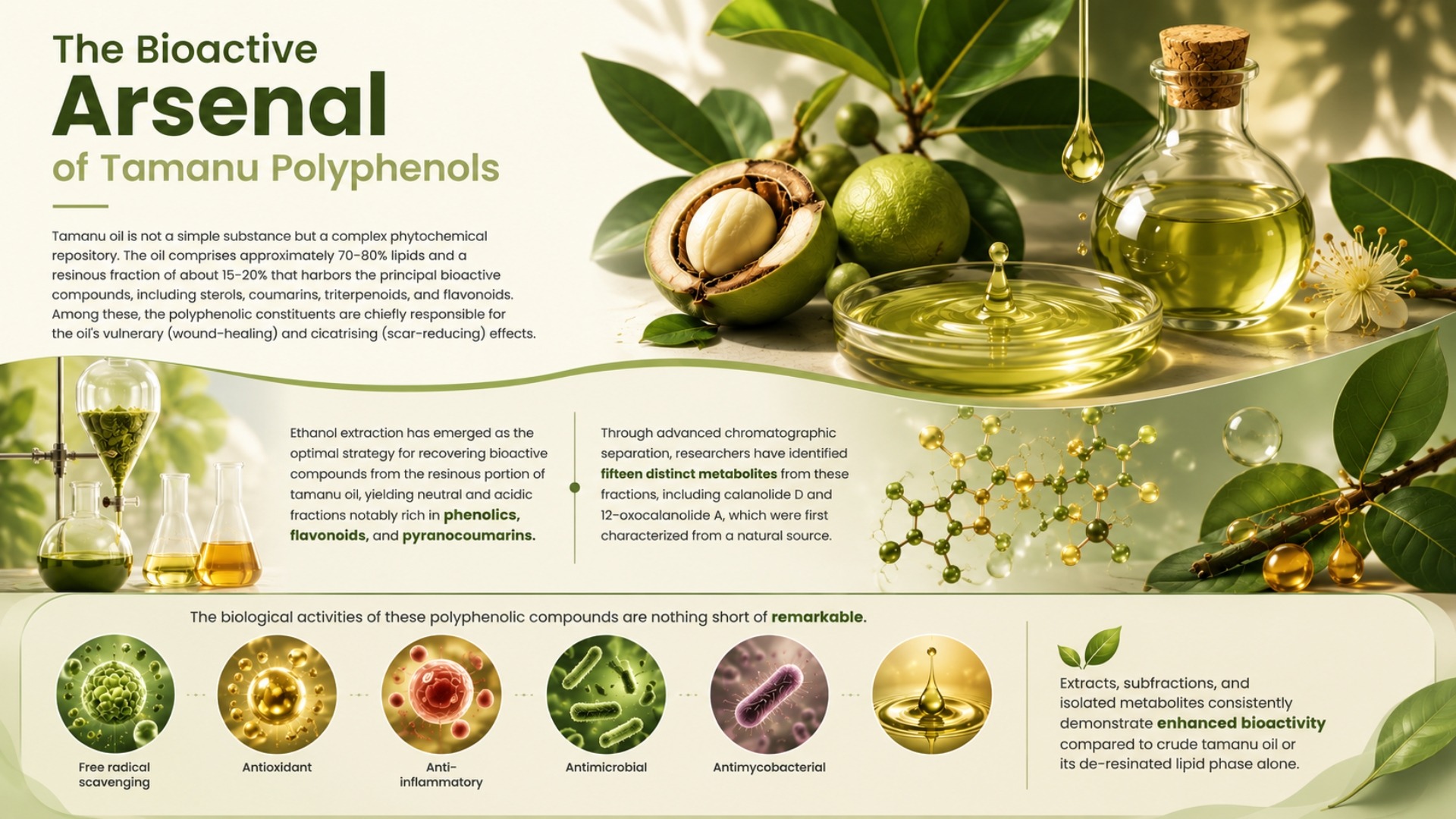
Tamanu oil is not a simple substance but a complex phytochemical repository. The oil comprises approximately 70–80% lipids and a resinous fraction of about 15–20% that harbors the principal bioactive compounds, including sterols, coumarins, triterpenoids, and flavonoids. Among these, the polyphenolic constituents are chiefly responsible for the oil's vulnerary (wound-healing) and cicatrising (scar-reducing) effects.
Ethanol extraction has emerged as the optimal strategy for recovering bioactive compounds from the resinous portion of tamanu oil, yielding neutral and acidic fractions notably rich in phenolics, flavonoids, and pyranocoumarins. Through advanced chromatographic separation, researchers have identified fifteen distinct metabolites from these fractions, including calanolide D and 12-oxocalanolide A, which were first characterized from a natural source.
The biological activities of these polyphenolic compounds are nothing short of remarkable. Extracts, subfractions, and isolated metabolites consistently demonstrate enhanced free radical scavenging, antioxidant, anti-inflammatory, antimicrobial, and antimycobacterial activity compared to crude tamanu oil or its de-resinated lipid phase alone.
Anti-Inflammatory and Immunomodulatory Actions
Recent investigations have illuminated the specific molecular mechanisms underlying tamanu polyphenols' anti-inflammatory effects. In LPS-stimulated RAW 264 macrophages and UVB-induced HaCaT keratinocytes, key compounds such as calophyllolide (CAL), inocalophyllin A (ICA), and inocalophyllin B (ICB) demonstrated potent anti-inflammatory activity. Calophyllolide was found to downregulate multiple pro-inflammatory cytokines, including TNF-α, IL-1β, IL-6, and IL-1α. ICA and ICB additionally suppressed CASP1, BAX, NLRP3, HDAC1, and HDAC2—key mediators of inflammatory and necroptotic signaling pathways. These findings underscore the multitargeted anti-inflammatory potential of tamanu polyphenols, positioning them as particularly valuable for conditions involving chronic inflammation and UV-induced skin damage.
Antimicrobial Potency
Beyond inflammation modulation, tamanu polyphenols exhibit formidable antimicrobial activity. Research conducted by the Bioscience and Biotechnology Research Center (PPBB) at Institut Teknologi Bandung (ITB) has demonstrated that tamanu polyphenol possesses antibacterial activity 4 to 5 times higher than that of tetracycline HCl—a standard antibiotic widely used for skin infections—against acne-causing bacteria such as Propionibacterium acnes and Staphylococcus epidermidis.
The mechanisms of action are multifaceted: the polyphenols disrupt bacterial and fungal cell membranes by increasing permeability, leading to leakage and cell death; they prevent biofilm formation—the protective layers that render bacteria resistant to treatment; and they induce oxidative stress within microbial cells, damaging DNA, proteins, and lipids. This triple-mechanism antibacterial strategy not only eliminates pathogens but also helps protect the skin from recurrent infections while accelerating cellular regeneration.
Wound Healing and Tissue Regeneration
The wound-healing capacity of tamanu polyphenols has been rigorously validated through in vitro models. Using the scratch assay on NIH 3T3 fibroblast cells, a polyphenol-rich fraction at a concentration of just 1 mcg/mL achieved an extraordinary 73.33 ± 0.34% wound closure. Cytotoxicity assays confirmed the safety profile of this fraction at this concentration, while crude tamanu oil demonstrated safety at substantially higher concentrations (250 mcg/mL and 100 mcg/mL). These data indicate that the polyphenol-rich fraction is not only more potent but also effective at far lower concentrations than the parent oil—a critical advantage for formulation development.
The Challenge: Delivering Potency to the Target
Despite their remarkable bioactivity, tamanu polyphenols confront inherent limitations that constrain their therapeutic utility when applied in conventional formulations. Polyphenolic compounds are generally susceptible to oxidative degradation, have limited solubility in aqueous environments, and struggle to penetrate the stratum corneum—the skin's primary barrier—in sufficient quantities to exert their effects at the cellular level.
These challenges are not unique to tamanu polyphenols; they represent a fundamental bottleneck in the development of effective phytochemical-based topical therapies. The solution lies not in abandoning these potent natural actives but in reimagining how they are delivered.
The Liposome Multiplier: A Delivery Technology Revolution
Liposomes, spherical vesicles composed of one or more phospholipid bilayers, have long been recognized as effective carriers for topical drug delivery. Their structural versatility allows for the encapsulation of both hydrophilic and hydrophobic compounds, protection of labile actives from degradation, and facilitated transport across biological membranes. However, the Liposome Multiplier concept elevates this technology to an entirely new level of performance.
Engineering the Optimal Liposomal Carrier
The formulation of tamanu polyphenol-loaded liposomes represents a masterclass in precision nanotechnology. Using the thin-layer hydration technique with soy lecithin as the lipid matrix and chloroform-ethanol as the solvent system, researchers have systematically optimized carrier parameters to achieve an ideal delivery profile.
The resulting liposomal formulation encapsulates the tamanu oil polyphenol-rich fraction with the following physicochemical characteristics:
|
Parameter |
Value |
|
Particle size |
145.4 ± 30.5 nm |
|
Polydispersity index |
0.310 ± 0.014 |
|
Zeta potential |
-8.5 ± 1.08 mV |
|
Encapsulation effeciency |
76.18% |
|
Appearance |
Translucent, aggregate-free |
These parameters are not arbitrary numbers—they are engineered specifications that collectively determine the system's performance. The particle size of approximately 145 nm falls within the ideal range for skin penetration, small enough to navigate intercellular spaces yet large enough to carry a substantial payload. The polydispersity index below 0.3 indicates a highly uniform population of vesicles, ensuring consistent delivery. The slightly negative zeta potential contributes to colloidal stability, preventing aggregation and maintaining the translucent, aggregate-free appearance essential for cosmetic and pharmaceutical applications.
The Multiplier Effect: How Liposomes Amplify Efficacy
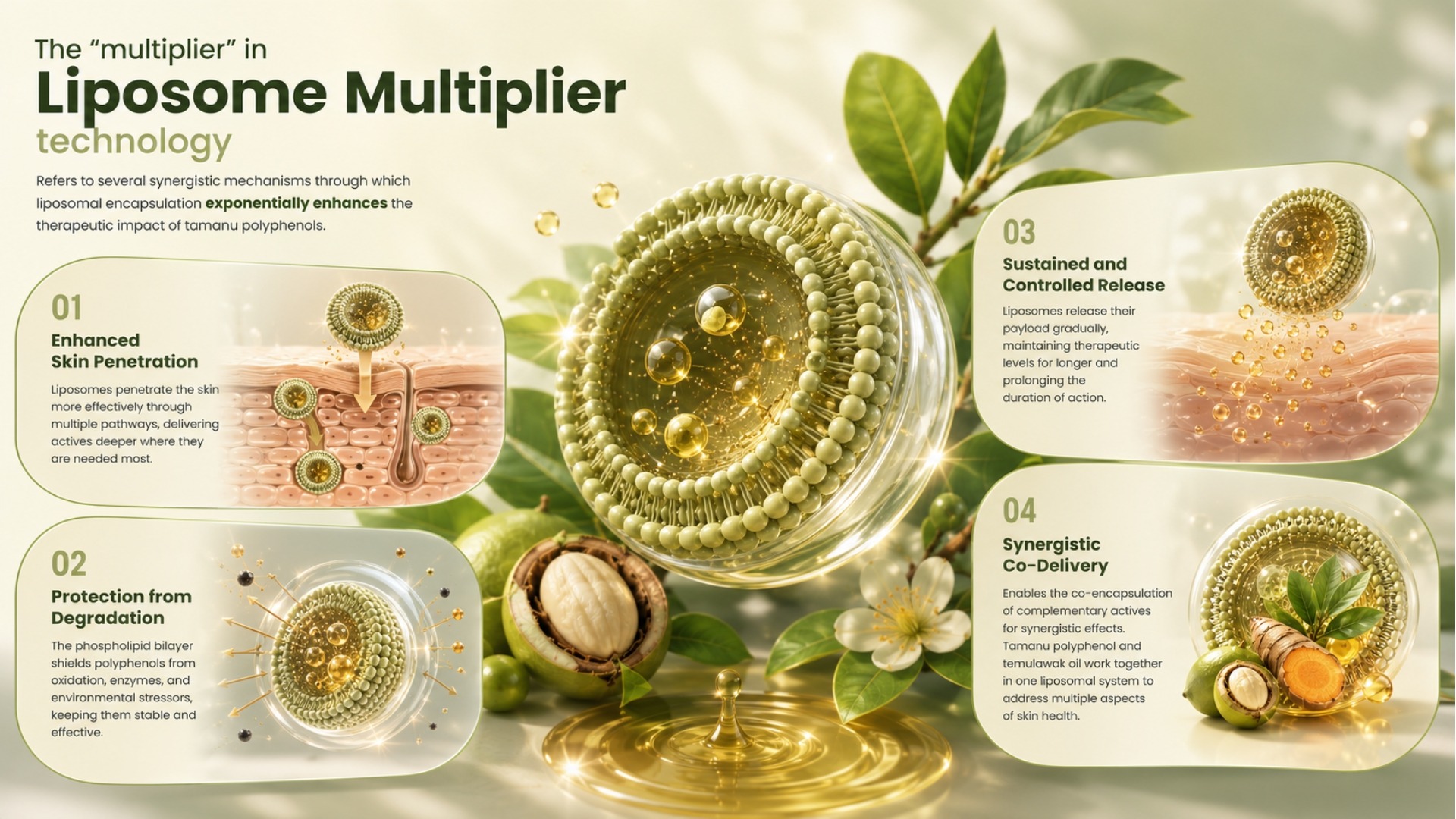
The "multiplier" in Liposome Multiplier technology refers to several synergistic mechanisms through which liposomal encapsulation **exponentially enhances** the therapeutic impact of tamanu polyphenols:
1. Enhanced Skin Penetration
Liposomes facilitate the transport of encapsulated actives across the stratum corneum through several pathways: they can fuse with skin lipids, creating transient permeation channels; they can be taken up by hair follicles and sweat ducts; and they can penetrate intercellular spaces due to their nanoscale dimensions. Research on analogous systems—tamanu oil-stabilized nanostructured lipid carriers—has demonstrated that nanoencapsulation can achieve approximately 15 times greater skin permeation compared to aqueous solutions of the active compound. This represents a 15-fold multiplication of bioavailability.
2. Protection from Degradation
The phospholipid bilayer of liposomes acts as a protective shield, safeguarding the encapsulated polyphenols from oxidation, enzymatic degradation, and other environmental stressors. This protection ensures that the active compounds remain intact until they reach their target site, multiplying the effective concentration available for therapeutic action.
3. Sustained and Controlled Release
Liposomes can provide sustained release of their payload, maintaining therapeutic concentrations over extended periods. This controlled release profile multiplies the duration of action, reducing the frequency of application required while maintaining consistent efficacy.
4. Synergistic Co-Delivery
The liposomal platform enables the co-encapsulation of complementary actives, facilitating synergistic therapeutic effects. The collaboration between PPBB ITB and ST Morita Farma has successfully combined tamanu polyphenol with temulawak oil (Curcuma xanthorrhiza) within a single liposomal formulation, creating a unique synergistic formula that addresses multiple aspects of skin health simultaneously.
Clinical and Preclinical Validation
The efficacy of the tamanu polyphenol liposome system is not theoretical—it is supported by robust experimental evidence.
Wound Healing
As previously noted, the polyphenol-rich fraction at 1 mcg/mL achieved 73.33% wound closure in fibroblast scratch assays, demonstrating potent regenerative activity at remarkably low concentrations. The liposomal formulation preserves and potentially enhances this activity while improving stability and bioavailability.
Anti-Inflammatory Synergy
In vivo studies using carrageenan-induced paw edema and Freund's adjuvant-induced arthritic models have demonstrated that tamanu oil exhibits synergistic anti-inflammatory potential when combined with other bioactive compounds. The co-delivery of multiple actives within a single liposomal carrier amplifies this synergy, creating an anti-inflammatory effect that exceeds the sum of its parts.
Clinical Outcomes
Clinical testing of tamanu polyphenol-based formulations has yielded impressive results. In a clinical study of a tamanu acne defense serum, 81% of subjects experienced a reduction in inflamed acne within 14 days. Pore size decreased by up to 86.8%, and 97% of users reported that the product helped control their acne. While these results reflect the combined effects of the total formulation, the liposomal delivery system is integral to achieving such rapid and substantial improvements.
The Liposome Multiplier as a Platform Technology
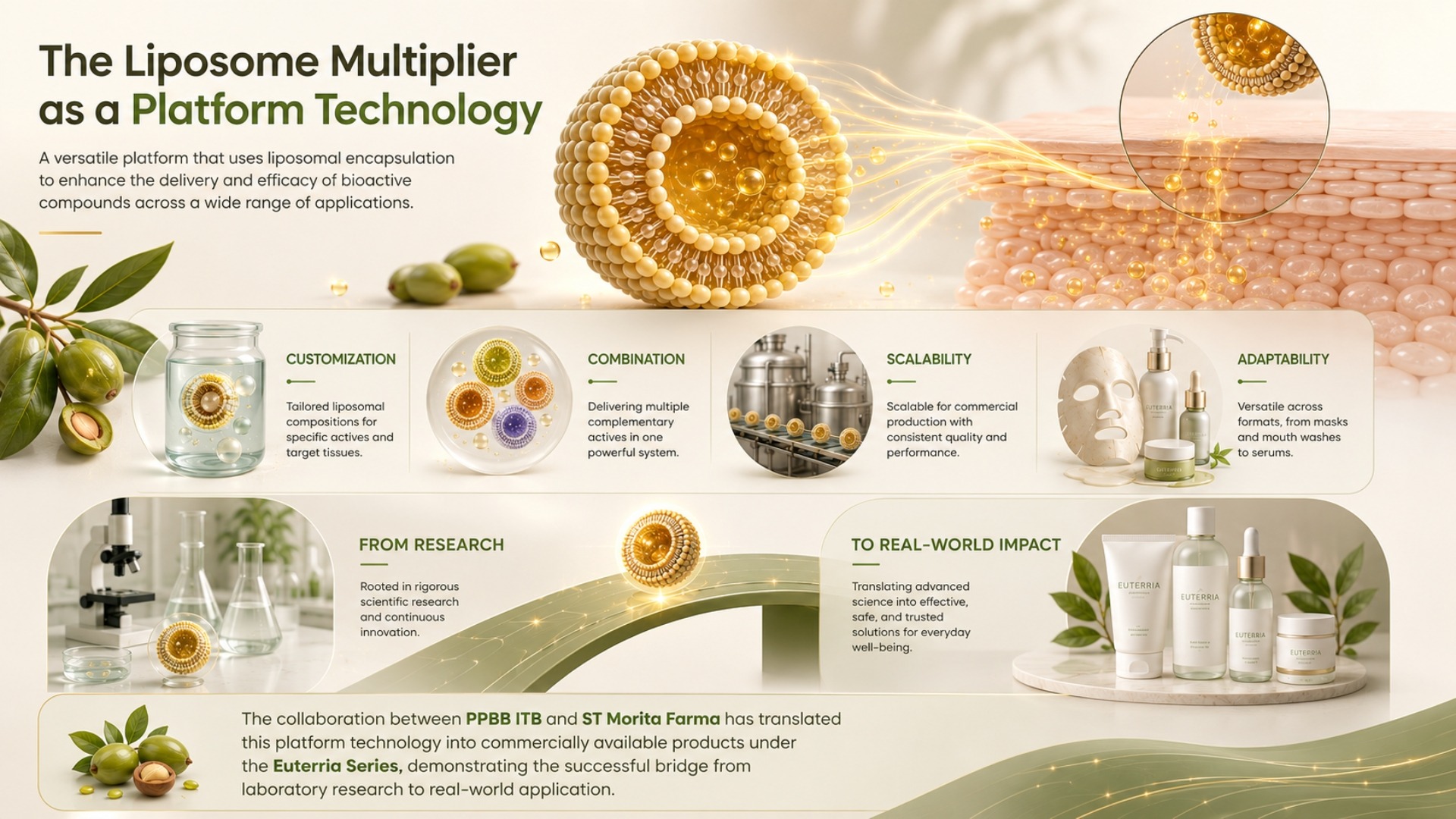
Perhaps the most significant aspect of the Liposome Multiplier technology is its versatility as a platform. The same principles of liposomal encapsulation that enhance tamanu polyphenol delivery can be applied to a wide range of bioactive compounds. This platform approach enables:
- Customization of liposomal compositions to suit specific actives and target tissues
- Combination therapies that deliver multiple complementary actives simultaneously
- Scalability for commercial production while maintaining quality and consistency
- Adaptability across product formats, from face masks and body masks to mouth washes and serums
The collaboration between PPBB ITB and ST Morita Farma has already translated this platform technology into commercially available products under the Euterria Series, demonstrating the successful bridge from laboratory research to real-world application.
Conclusion
Tamanu polyphenols represent one of nature's most sophisticated molecular arsenals for skin health, combining potent antioxidant, anti-inflammatory, antimicrobial, and regenerative activities within a single phytochemical complex. Yet their full potential has historically been constrained by the limitations of conventional delivery systems.
The Liposome Multiplier technology liberates these bioactive compounds from these constraints. Through precision-engineered liposomal encapsulation, the technology achieves a multiplication of efficacy —enhancing penetration, protecting against degradation, enabling sustained release, and facilitating synergistic combinations. The result is a delivery system that honors the wisdom of traditional medicine while harnessing the power of modern nanotechnology.
As research continues to unfold the full therapeutic spectrum of tamanu polyphenols, and as liposomal delivery technologies grow increasingly sophisticated, the synergy between these two domains promises to yield ever more effective solutions for skin health and beyond. The Liposome Multiplier is not merely a delivery system—it is a force multiplier for nature's own pharmacy.
References
1. Dweck AC, Meadows T. Tamanu (Calophyllum inophyllum) - the African, Asian, Polynesian and Pacific Panacea. International Journal of Cosmetic Science. 2002;24(6):341-348. doi:10.1046/j.1467-2494.2002.00160.x
2. Cassien M, et al. Improving the Antioxidant Properties of Calophyllum inophyllum Seed Oil from French Polynesia: Development and Biological Applications of Resinous Ethanol-Soluble Extracts. Antioxidants. 2021;10(2):199. doi:10.3390/antiox10020199
3. Anti-inflammatory and UV-protective activities of isolated compounds from Calophyllum inophyllum L. in immune and skin cell models. Journal of Natural Medicines. 2026;80:179-191
4. Pribowo A, Girish J, Gustiananda M, Nandhira RG, Hartrianti P. Potential of Tamanu (Calophyllum inophyllum) Oil for Atopic Dermatitis Treatment. Evidence-Based Complementary and Alternative Medicine. 2021;2021:6332867. doi:10.1155/2021/6332867
5. Tamanu oil-stabilized nanostructured lipid carriers (TQ-NLCs) for thymoquinone delivery. Drug Delivery and Translational Research. 2022
6. Formulasi Liposom Minyak Tamanu Polyphenol Rich Fraction serta Efek Penyembuhan Luka pada Sel NIH 3T3. Perpustakaan Digital ITB
7. PPBB ITB dan ST Morita Farma Kembangkan Produk Inovatif Berbasis Tamanu Polyphenol. Suara Merdeka. 2025
8. Preparation and characterization of liposomes encapsulating Calophyllum inophyllum oil. Vietnam Journal of Science and Technology. 2017
9. Multivesicular Liposome: A Lipid-based Drug Delivery System for Efficient Drug Delivery. PubMed
10. PPBB ITB dan St Morita Farma Kembangkan Produk Kosmetik Berbasis Tamanu Polyphenols. Tribunjabar.id. 2025
11. Maudy Ayunda X ITB Hasilkan Tamanu Oil Sulawesi. Marketing.co.id. 2026
Editorial Team:
- Rafi Rif'atul Rizki, S.I.Kom.