DECODING GLOBAL REGULATORY REQUIREMENTS FOR MITRAGYNINE MARKET ENTRY
Author: Adrian S. Siregar, Ph.D. | Editor-in-Chief: Sandy Akbar Nusantara, S.T., M.B.A. | Published: June 26, 2026

Sourcing a high-purity mitragynine extract is only half the challenge. The more difficult and often more expensive step is navigating the regulatory framework that governs how kratom-derived ingredients can be marketed, imported, distributed, and sold across global jurisdictions.
For procurement managers, brand owners, and product development teams, regulatory compliance has become a critical competitive differentiator. The same quality systems discussed throughout this series including cGMP manufacturing, alkaloid fingerprinting, contaminant testing, and supply chain traceability now serve a second purpose: demonstrating regulatory readiness.
The challenge is that no unified global framework exists for kratom products. Instead, companies face a patchwork of federal, state, and international regulations that can differ dramatically from one jurisdiction to another. A product that may be legally sold in one U.S. state may be prohibited in another. A formulation accepted in Southeast Asia may trigger Novel Food requirements in Europe. A shipment legally exported from Indonesia may encounter import restrictions elsewhere.
This article provides a practical roadmap for navigating those complexities and transforming quality documentation into a market-entry strategy.
Understanding the U.S. Regulatory Landscape
Federal Status: Legal but Not Fully Accepted
The United States remains the world's largest commercial market for kratom products, yet it also presents one of the most complicated regulatory environments.
At the federal level, kratom and mitragynine are not currently scheduled under the U.S. Controlled Substances Act. Previous efforts by the Drug Enforcement Administration (DEA) to place mitragynine and 7-hydroxymitragynine into Schedule I were ultimately withdrawn after significant public and congressional opposition.
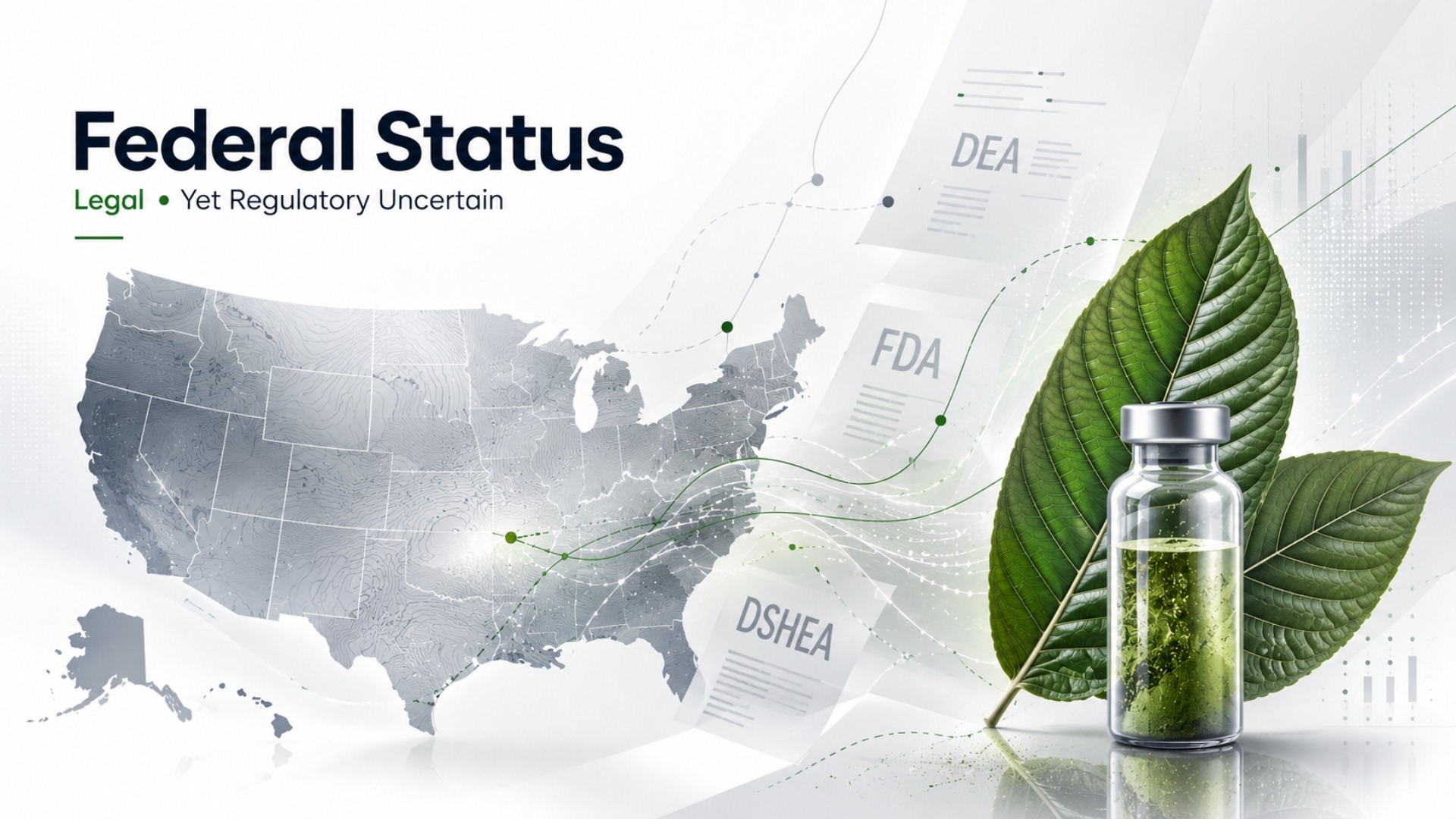 However, the absence of federal scheduling should not be interpreted as regulatory approval. The U.S. Food and Drug Administration (FDA) continues to maintain that kratom-containing products are not approved dietary ingredients and has repeatedly asserted that kratom does not qualify as a lawful dietary supplement ingredient under existing interpretations of the Dietary Supplement Health and Education Act (DSHEA). The agency has issued warning letters, import alerts, and enforcement actions against companies making therapeutic claims or marketing adulterated products.
This creates a regulatory paradox:
Kratom is not federally scheduled as a controlled substance.
Yet kratom is not formally recognized by the FDA as an approved dietary ingredient.
Enforcement is largely risk-based and focused on safety concerns, contamination issues, and disease-treatment claims.
For brands, this means product quality alone does not eliminate regulatory exposure. Even highly purified extracts produced under rigorous quality systems operate within a legal gray zone.
Why Voluntary Compliance Matters
In the absence of a comprehensive federal framework, industry-led standards have become increasingly important.
The American Kratom Association (AKA) cGMP Standards Program and related industry quality initiatives have emerged as the de facto compliance benchmark for responsible manufacturers.
These programs typically emphasize:
Current Good Manufacturing Practices (cGMP)
Identity testing
Alkaloid profiling
Heavy metal screening
Microbiological testing
Residual solvent testing
Traceability systems
Adverse event reporting procedures
While voluntary standards do not provide immunity from FDA enforcement, they can demonstrate a company's commitment to product safety and quality control.
For insurers, distributors, retail partners, and legal counsel, documented adherence to recognized industry standards often serves as evidence that a company has taken reasonable steps to mitigate foreseeable risks.
The Kratom Consumer Protection Act (KCPA) Movement
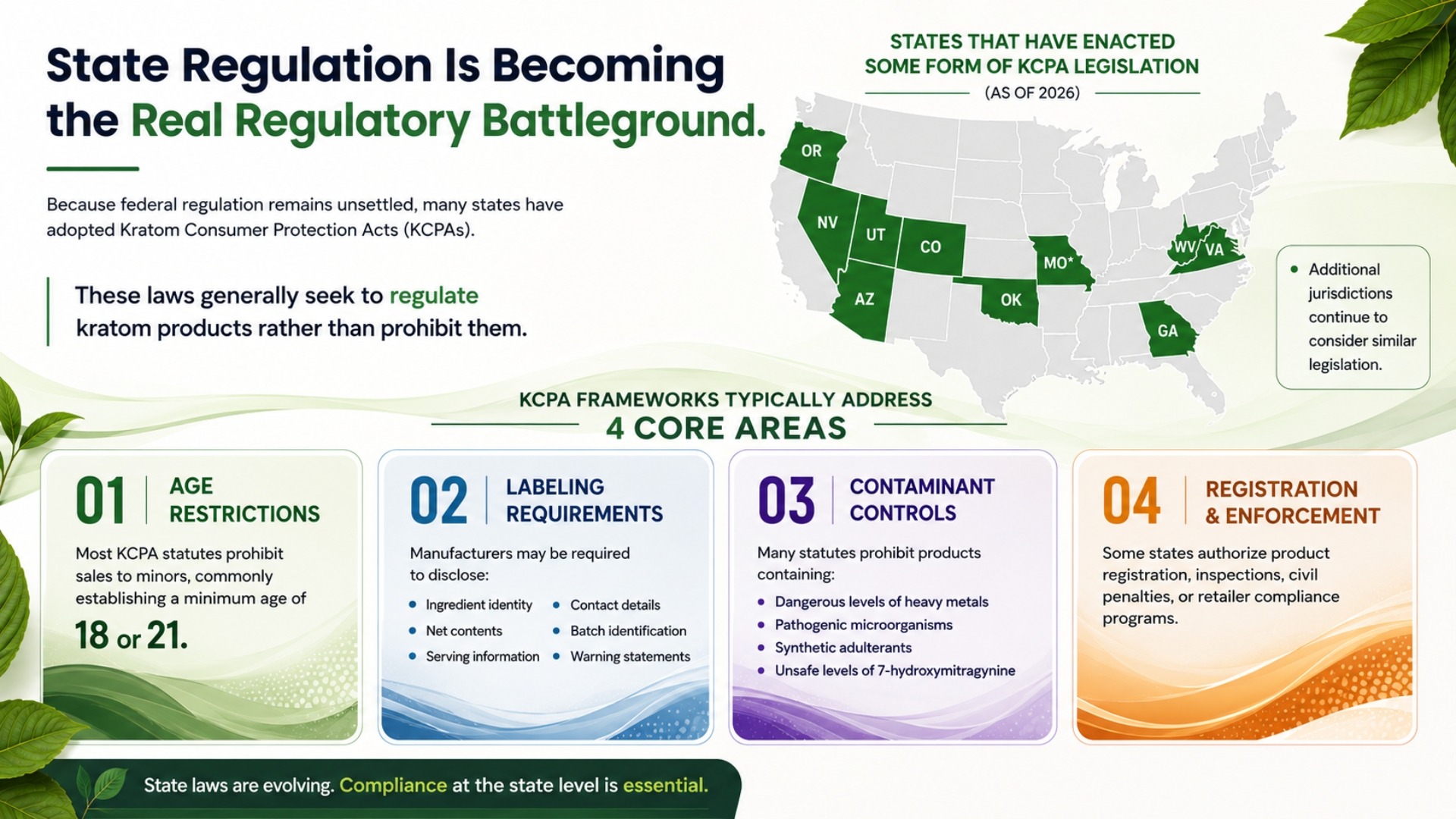
State Regulation Is Becoming the Real Regulatory Battleground. Because federal regulation remains unsettled, many states have adopted Kratom Consumer Protection Acts (KCPAs). These laws generally seek to regulate kratom products rather than prohibit them. As of 2026, states that have enacted some form of KCPA legislation include:
Utah
Arizona
Georgia
Nevada
Oklahoma
Colorado
Oregon
Virginia
West Virginia
Missouri (certain provisions)
Additional jurisdictions continue to consider similar legislation.
Although requirements vary by state, KCPA frameworks typically address four core areas:
- Age Restrictions
- Most KCPA statutes prohibit sales to minors, commonly establishing a minimum age of 18 or 21.
- Labeling Requirements
Manufacturers may be required to disclose:
- Ingredient identity
- Net contents
- Serving information
- Contact details
- Batch identification
- Warning statements
- Contaminant Controls
Many statutes prohibit products containing:
- Dangerous levels of heavy metals
- Pathogenic microorganisms
- Synthetic adulterants
- Unsafe levels of 7-hydroxymitragynine
- Registration and Enforcement
- Some states authorize product registration, inspections, civil penalties, or retailer compliance programs.
States with Restrictions or Prohibitions
A separate group of jurisdictions continues to maintain bans or significant restrictions on kratom products. Because legislation changes frequently, companies should perform jurisdiction-specific legal reviews before launch rather than relying on generalized national guidance. A critical mistake made by many emerging brands is assuming federal legality determines market access. In reality, the state of sale often dictates whether a product can legally reach consumers. Market-entry planning therefore requires a state-by-state assessment before inventory is deployed.
European Union: The Novel Food Barrier
Why Europe Is Different
For many botanical ingredient suppliers, the European Union appears attractive because of its large consumer supplement market. In practice, however, the EU may represent the most challenging pathway for mitragynine-containing products.
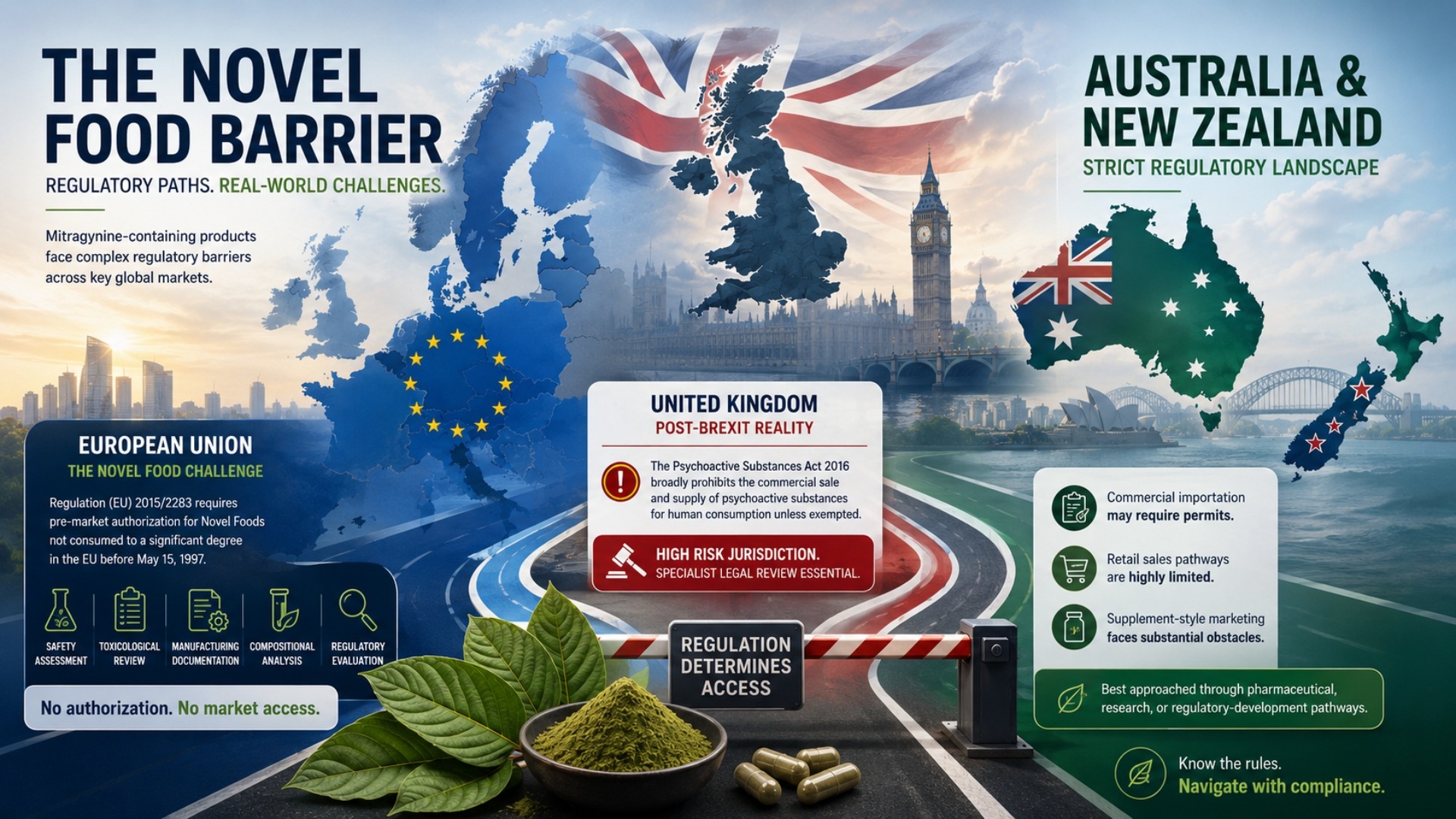
The primary obstacle is Regulation (EU) 2015/2283 governing Novel Foods. Under the Novel Food framework, foods not consumed to a significant degree within the European Union before May 15, 1997 generally require pre-market authorization before commercialization. The authorization process involves safety assessment, toxicological review, manufacturing documentation, compositional analysis, and regulatory evaluation.
For mitragynine-containing extracts, regulators may determine that the ingredient qualifies as a Novel Food, triggering authorization requirements before legal sale. The European Commission's Novel Food Catalogue serves as a reference point, although final determinations depend on product-specific facts and evidence.
United Kingdom: Post-Brexit Reality
The Impact of the Psychoactive Substances Act
Following implementation of the Psychoactive Substances Act 2016, the commercial sale and supply of psychoactive substances for human consumption became broadly prohibited unless specifically exempted. Government guidance indicates that production, supply, and distribution activities involving psychoactive substances intended for human consumption may trigger criminal liability.
Although legal interpretations continue to evolve, kratom products are generally regarded as falling within the scope of significant restrictions under the UK's current framework. Industry participants therefore face substantial barriers to lawful commercial sales. For practical purposes, most companies should assume that the United Kingdom is a high-risk jurisdiction requiring specialist legal review before importation, distribution, or marketing activities are undertaken.
Australia and New Zealand
Therapeutic Goods Regulation
Australia maintains one of the most restrictive regulatory approaches to mitragynine-containing products. The country's therapeutic goods and poisons scheduling framework has historically treated mitragynine-related substances as controlled substances requiring regulatory authorization.
Consequently:
Commercial importation may require permits.
Retail sales pathways are highly limited.
Dietary supplement-style marketing models generally face substantial obstacles.
New Zealand similarly applies a cautious regulatory posture toward psychoactive and medicinally active substances. Companies targeting Australia or New Zealand should obtain jurisdiction-specific legal advice before investing in distribution infrastructure. For many exporters, these markets are better approached through pharmaceutical, research, or regulatory-development pathways rather than conventional supplement channels.
Turning Quality Documentation Into Regulatory Documentation
The Documentation Regulators Actually Want
One of the most important lessons for procurement teams is that regulatory compliance rarely begins with new paperwork. Instead, regulators often ask for evidence that should already exist if a product has been sourced responsibly. The strongest suppliers routinely generate documentation that aligns directly with regulatory expectations.
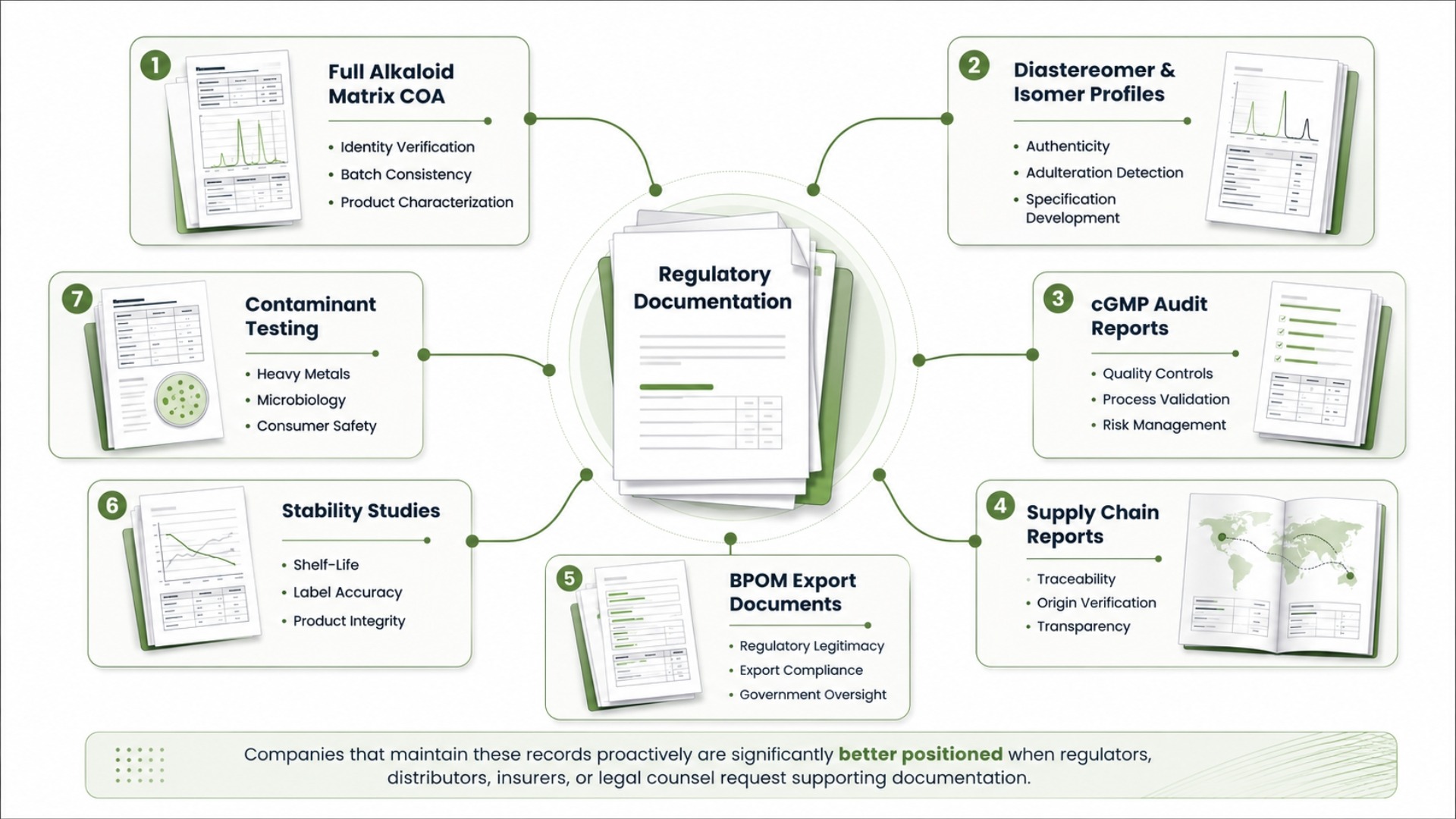
Full Alkaloid Matrix COA
Supports:
Identity verification
Product characterization
Batch consistency
Diastereomer and Isomer Profiles
Supports:
Authenticity verification
Adulteration detection
Product specification development
cGMP Audit Reports
Supports:
Manufacturing quality controls
Process validation
Risk management
Surveyor and Chain-of-Custody Reports
Supports:
Traceability
Origin verification
Supply chain transparency
BPOM Export Documentation
Supports:
Regulatory legitimacy
Export compliance
Government oversight
Stability Studies
Supports:
Shelf-life claims
Label accuracy
Product integrity
Contaminant Testing
Supports:
Heavy metal compliance
Microbiological safety
Consumer protection requirements
Companies that maintain these records proactively are significantly better positioned when regulators, distributors, insurers, or legal counsel request supporting documentation.
Litigation as a Regulatory Proxy
The Enforcement Mechanism That Never Sleeps
An emerging trend in the kratom sector is the growth of product liability litigation and consumer class-action lawsuits. In many cases, civil litigation functions as a de facto regulatory enforcement mechanism. Even where regulatory agencies have not taken action, plaintiffs' attorneys may challenge:
Product labeling
Safety representations
Marketing claims
Manufacturing practices
Failure-to-warn allegations
Contamination events
This environment creates substantial financial risk. A company can technically comply with applicable regulations and still face litigation exposure if documentation is inadequate.
Reducing Legal Exposure
Sophisticated operators increasingly employ multiple layers of protection:
- Product Liability Insurance
- Coverage should be reviewed specifically for botanical extracts and kratom-related products.
- Supplier Indemnification Agreements
- Contracts should allocate responsibility for contamination, adulteration, and specification failures.
- Third-Party Testing
- Independent verification strengthens defensibility.
- Batch-Level Traceability
- Every finished product should be traceable to specific raw material lots.
- Documentation Retention Programs
- Maintain records beyond minimum regulatory requirements.
- Claim Substantiation Files
- All marketing claims should be supported by documented evidence. The cost of building these systems is often significantly lower than the cost of defending a single major lawsuit.
Regulatory Readiness Self-Assessment
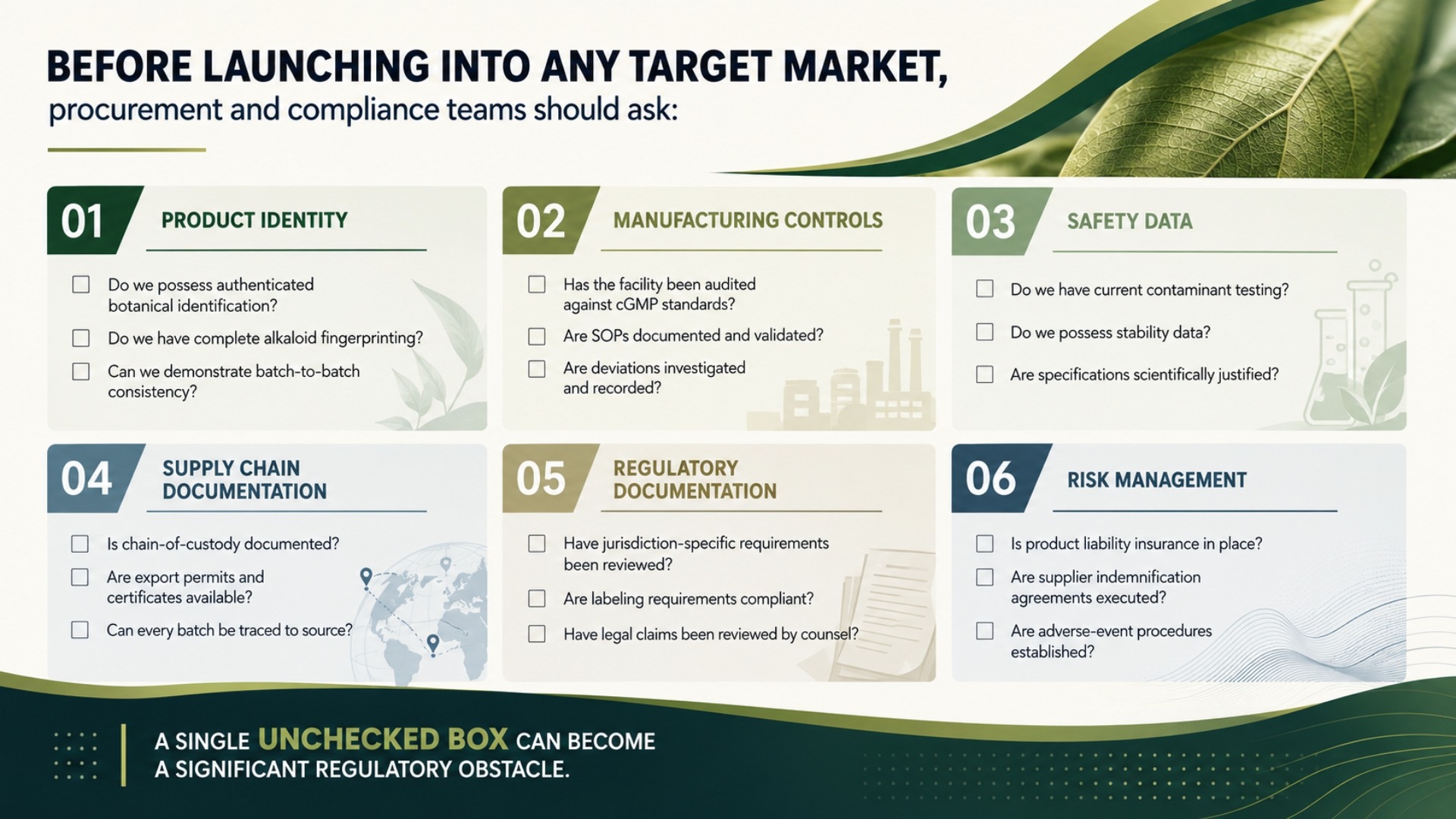
Before launching into any target market, procurement and compliance teams should ask:
Product Identity
- Do we possess authenticated botanical identification?
- Do we have complete alkaloid fingerprinting?
- Can we demonstrate batch-to-batch consistency?
Manufacturing Controls
- Has the facility been audited against cGMP standards?
- Are SOPs documented and validated?
- Are deviations investigated and recorded?
Safety Data
- Do we have current contaminant testing?
- Do we possess stability data?
- Are specifications scientifically justified?
Supply Chain Documentation
- Is chain-of-custody documented?
- Are export permits and certificates available?
- Can every batch be traced to source?
Regulatory Documentation
- Have jurisdiction-specific requirements been reviewed?
- Are labeling requirements compliant?
- Have legal claims been reviewed by counsel?
Risk Management
- Is product liability insurance in place?
- Are supplier indemnification agreements executed?
- Are adverse-event procedures established?
A single unchecked box can become a significant regulatory obstacle.
Conclusion
The future of the mitragynine industry will be shaped as much by compliance as by product quality. High-purity extracts, advanced manufacturing systems, and sophisticated analytical testing are increasingly becoming baseline expectations rather than differentiators. What separates successful market entrants from failed launches is the ability to convert those quality systems into a defensible regulatory framework.
The companies most likely to succeed are those that view compliance not as a cost center, but as a strategic asset. By aligning sourcing, manufacturing, documentation, and legal preparedness from the beginning, brands can enter new markets with greater confidence, lower regulatory risk, and stronger long-term credibility.
In an industry defined by evolving regulation, documentation is no longer merely evidence of quality.
References:
U.S. Food and Drug Administration (FDA). Public statements, warning letters, and import alerts regarding kratom products and dietary supplement compliance.
Drug Enforcement Administration (DEA). Historical notices regarding scheduling considerations for mitragynine and 7-hydroxymitragynine.
European Commission. Novel Food Regulation (EU) 2015/2283 and Novel Food Guidance.
European Food Safety Authority (EFSA). Novel Food Risk Assessment Framework and Authorization Process.
UK Government. Psychoactive Substances Act 2016 Guidance for Retailers and Researchers.
UK Government. Psychoactive Substances Penalties and Enforcement Guidance.
American Kratom Association (AKA). GMP Standards Program and Industry Compliance Resources.
Mayer Brown LLP. Emerging Kratom Litigation and Product Liability Developments (2026).
State Kratom Consumer Protection Act (KCPA) statutes and legislative records across applicable U.S. jurisdictions.
Indonesian National Agency of Drug and Food Control (BPOM) export documentation and botanical ingredient compliance guidance.
Editorial Team:
- Afifah Rahma Adila, S.Si.
- Fajar Fadillah Denitasari, S.T.
Illustrator:
- Rafi Rif'atul Rizki, S.I.Kom.